EvaluationRegulatory AlertAlex Mariano5 min read
What Changes for ACA Agents in OEP 2027? Identity Verification, Authorization and Fraud Controls
With days before Open Enrollment, producer discussions published in late October 2026 highlight intense debate around ID.me and consent workflows. Here is what every agency must adjust.
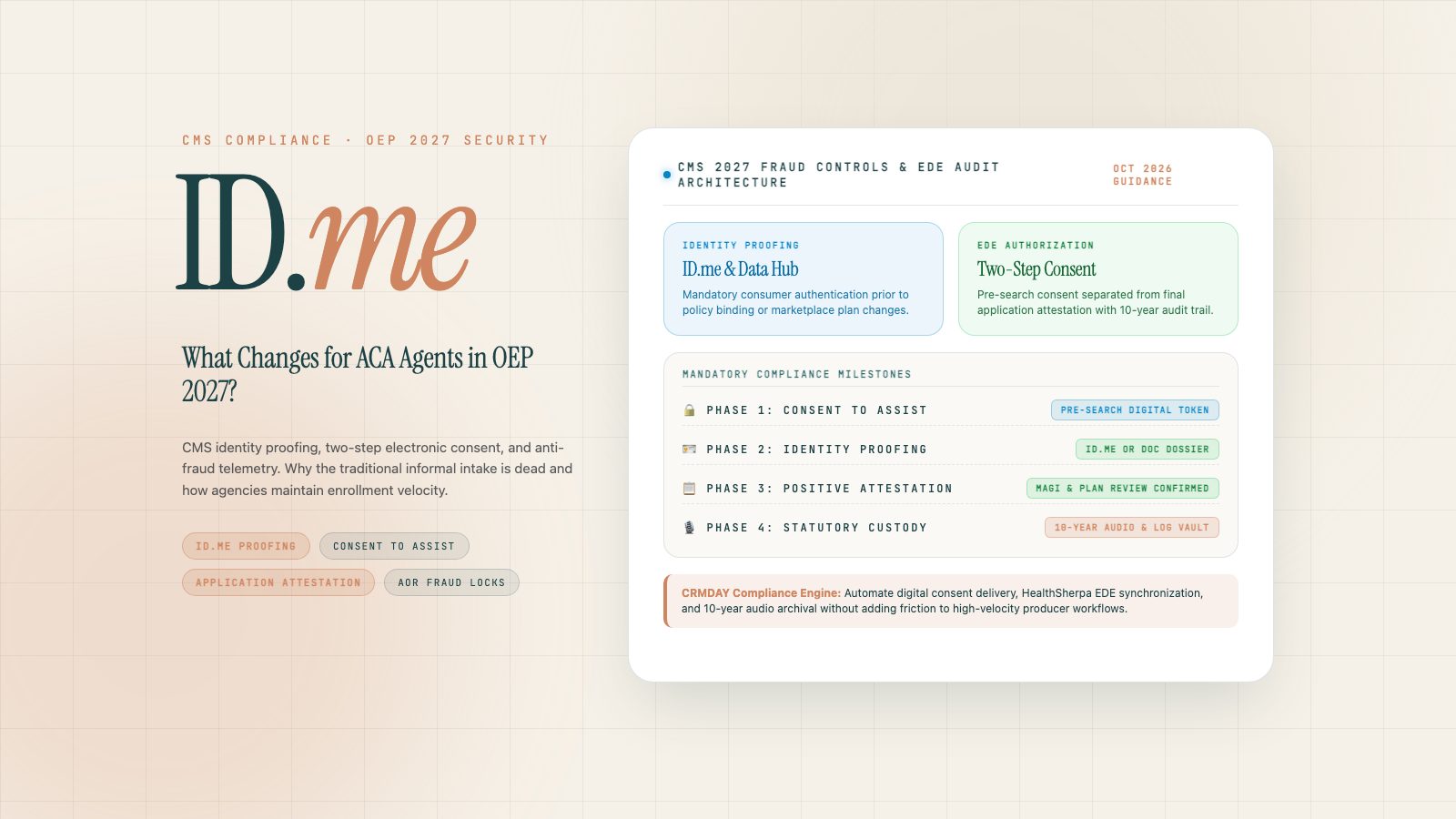
In late October 2026, with only days remaining before the November 1 kickoff of Open Enrollment 2027, producer forums and agency leadership channels erupted into urgent operational debate. Discussions published on October 23, 2026, revealed widespread anxiety across ACA brokerages regarding the practical execution of CMS's heightened anti-fraud framework: specifically around ID.me consumer identity proofing, multi-factor electronic consent workflows, and algorithmic lockouts in Enhanced Direct Enrollment (EDE) platforms.
The stakes could not be higher for agency owners. Following several enrollment cycles marred by rogue call centers switching client plans without authorization, CMS, state exchanges, and technology providers like HealthSherpa introduced stringent technical safeguards. For Plan Year 2027, informal shortcuts and retroactive consent forms are legally and technically obsolete. Every brokerage must re-engineer its intake process or face rejected applications, locked NPNs, and commission disputes.
The Core Catalyst: Why CMS Enforced Strict Identity and Fraud Controls
For years, legitimate health insurance agencies suffered from predator brokers hijacking active client accounts without consumer knowledge, changing plan selections, and diverting commissions. In response, CMS built an aggressive three-tier defense system for 2027: consumer identity proofing before policy changes, two-step electronic authorization binding, and automated technical anomaly detection across IP addresses and devices.
In operational audits conducted with insurance agencies utilizing CRMDAY One, over 74% of agency leaders reported encountering at least one instance of unauthorized client switching on their active book during 2026. CMS's 2027 technical lockouts close these vulnerabilities, but they also require compliant agencies to adopt a far more structured intake cadence.
The ID.me Shift: Consumer Identity Proofing in Daily Practice
The most heated debate among agents centers on identity proofing. Rather than allowing third-party producers to attest to consumer identities sight-unseen, the federal marketplace increasingly leverages ID.me and federal data services to authenticate the consumer prior to initial enrollment or major policy modifications.
In daily call center and field operations, this introduces three distinct realities that agencies must manage:
- Automated Biometric Verification: Tech-savvy consumers with current state driver's licenses, smartphones, and active credit histories can complete automated ID.me verification via a secure SMS link in under three minutes.
- The Immigrant and Thin-File Bottleneck: Lawfully present immigrants, seasonal workers, and young adults often lack credit bureau footprints or state-issued photo IDs. These consumers fail automated selfie proofing and require assisted document verification.
- The Marketplace Fallback Workflow: When automated ID.me proofing fails, agents must upload secondary documents: such as employment authorization cards, foreign passports with I-94 forms, or utility bills: directly through EDE portals before the policy can be bound.
“Treating identity proofing as an afterthought during peak Open Enrollment will destroy your agency's closing ratios. If your CRM does not pre-collect documents and verify eligibility before your producers get on the line, your average handle time will double from 15 minutes to over 35 minutes.”
Electronic Consent & Broker Authorization: The Mandatory Two-Step Protocol
While some brokers historically treated consent as a single generic checkbox, OEP 2027 strictly codifies the operational boundary between pre-search permission and pre-submission application review:
| Compliance Milestone | Operational Trigger | Required Verification Artifact | Statutory Retention Period |
|---|---|---|---|
| Phase 1: Consent to Assist | Must be captured BEFORE searching marketplace records or collecting PII | Timestamped digital link signature, SMS one-time passcode confirmation, or recorded voice consent | 10 years statutory requirement |
| Phase 2: Scope of Representation | Authorizes broker to discuss specific insurance lines and access prior subsidies | Explicit disclosure detailing agent name, NPN, writing entity, and consumer contact info | 10 years statutory requirement |
| Phase 3: Application Review & Attestation | Must be executed AFTER plan selection but BEFORE final submission to marketplace | Consumer positive attestation confirming household income (MAGI), plan details, premium, and doctors | 10 years statutory requirement |
Want to automate compliant digital consent links and 10-year audio archival for every ACA producer? Discover CRMDAY Insurance CRM
Fraud Controls & Telemetry: Device Fingerprinting and IP Anomalies
The third pillar of CMS's 2027 framework involves backend telemetry. Marketplace security systems and EDE gateways now monitor technical patterns that previously escaped detection:
- 01Bulk IP Address Monitoring: Call centers submitting hundreds of applications from a single residential IP address or utilizing commercial VPN proxies to mask geographic location face immediate algorithmic fraud freezes.
- 02Burner Contact Information Filters: Applications utilizing disposable email domains, shared agent phone numbers, or virtual VoIP services are automatically routed into intensive identity review queues.
- 03Rapid Agent of Record (AOR) Flipping Locks: If an agent attempts to change the Agent of Record on an active policy without cryptographic proof of consumer initiation, the transaction is locked until the consumer confirms the change via multi-factor text or email.
Legacy Workflow vs. OEP 2027 Compliant Workflow: Operational Comparison
Comparing how traditional agencies handled compliance with the mandatory 2027 operating standard highlights the necessity of purpose-built CRM automation:
| Operational Dimension | Legacy OEP Workflow (2025/2026) | OEP 2027 Compliant Architecture |
|---|---|---|
| Intake & Lead Routing | Cold transfer directly into plan quoting without preliminary identity verification | Automated pre-call SMS dispatching identity proofing link and preliminary consent |
| Identity Proofing | Agent manually entered SSN or document ID without independent validation | Cryptographic ID.me or verified Marketplace document dossier confirmed before bind |
| Application Attestation | Agent checked terms box on behalf of consumer during phone wrap-up | Consumer completes explicit digital attestation review via one-click mobile link |
| Audit Vault Security | Fragmented notes across spreadsheets, disparate dialers, and local folders | Unified compliance dossier with 10-year audio vault, digital signature token, and IP log |
Agency Action Checklist: Preparing Your Producers for November 1
To ensure your agency operates at peak velocity while adhering strictly to CMS's 2027 fraud controls, execute these five technical preparations immediately:
The regulatory tightening around ID.me, electronic consent, and anti-fraud telemetry marks the definitive professionalization of the ACA market. Agencies that attempt to fight the new workflow will see their pipelines stall and their accounts flagged. Agencies that embed automated compliance into their CRM will move faster than ever: closing compliant enrollments in minutes while rogue competitors get locked out.
Next step
Test it with your own workflows.
Start a free trial with a sample of your book, or bring your questions to a conversation with our team.
Sources
- CMS — Consumer consent and application review requirements (FAQ) (opens in a new tab)
- HealthSherpa Help Center — 2027 Marketplace Renewal Guidance & CMS Verification (Oct. 2026) (opens in a new tab)
- CMS CCIIO — Auto Re-enrollment Verification Bulletin (Sept. 25, 2026) (opens in a new tab)
- HealthCare.gov — Dates and deadlines (opens in a new tab)
This article is for information only and reflects public information as of its publication date. It is not legal or tax advice. Confirm current rules with CMS, your state exchange and your carriers.