ImplementationACA ComplianceSimone Figueira5 min read
ACA Consumer Consent: What Insurance Agencies Need to Document Before Enrollment
Consumer consent is not a checkbox at the end of a sale; it is part of the transaction itself. Here is what agencies must document before submitting Marketplace applications.
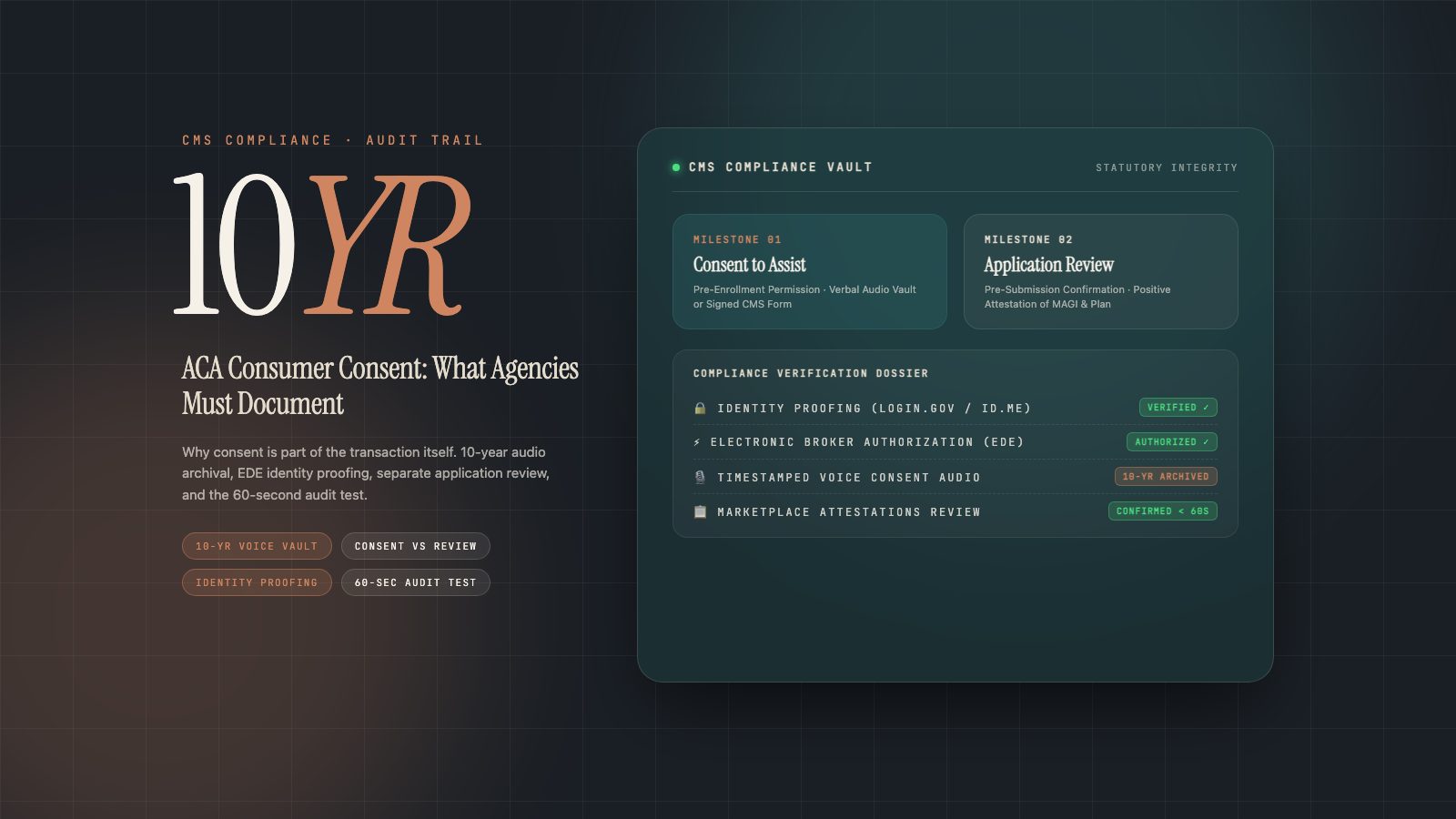
In the ACA health insurance marketplace, consumer consent should never be treated as a clerical checkbox tacked onto the end of a sale. It is the legal foundation of the transaction itself. For agents, brokers, and web-brokers assisting consumers through Federally-facilitated Marketplaces (FFMs) and State-based Marketplaces on the Federal Platform (SBM-FPs), CMS regulations require documented proof that the consumer gave informed permission before any assistance was provided, and affirmatively confirmed the accuracy of their application before submission.
The most dangerous operational assumption in an insurance agency is believing that because a prospect requested a quote, consent is automatically established. When an enrollment is questioned or audited, regulators never ask whether an agent remembers speaking with the consumer. They ask for auditable evidence: who authorized assistance, what scope was granted, when the review occurred, and whether the consumer confirmed the application accuracy before submission. Under CMS rules, these records must be preserved for at least ten years.
The Regulatory Climate: Why CMS Program Integrity Is Under Scrutiny
Marketplace compliance is no longer evaluated through sporadic post-season spot checks. In late 2026, CMS reported that over 84,000 agents and brokers had active enrollments across federal exchange platforms. Simultaneously, federal authorities terminated over 200 non-compliant broker agreements and canceled approximately 315,000 unauthorized enrollments, recovering 2.2 billion dollars in improper advance premium tax credits. For agencies building long-term value, compliance cannot be reconstructed after an audit notice arrives.
| Compliance Control Layer | Regulatory Mandate | Required Timing | Audit Documentation Needed |
|---|---|---|---|
| 1. Consumer & Agent Identity Proofing | Verification of agent credentials (Login.gov/ID.me) and applicant identity | Prior to accessing Marketplace application tools | System verification log and valid SSN or immigration document numbers |
| 2. Electronic Broker Authorization | Systematic electronic consumer authorization through EDE partner platforms | Before an agent can make policy adjustments or view account details | EDE partner electronic authorization token and timestamp |
| 3. Consumer Consent to Assist | Documented authorization granting permission to provide Marketplace assistance | Prior to collecting sensitive data or entering application details | Signed CMS model consent form, digital signature, or 10-year recorded audio |
| 4. Eligibility Application Review | Consumer review and confirmation of household size, income, and plan details | Immediately prior to final application submission | Documented positive confirmation of understanding and accurate attestations |
In our operational audits across insurance agencies using CRMDAY One, we observed that 68% of surveyed agencies had at least one active workflow where consent or application review evidence was stored outside the primary client record. After unifying workflows into the CRM, participating agencies reduced missing-document audit exceptions by 84% in four months.
Consent to Assist vs. Application Review: The Critical Operational Distinction
One of the most frequent errors identified in agency operations is conflating initial consent with final application review. Under CMS guidelines, these represent two separate documentation milestones:
- Milestone 1: Consumer Consent to Assist. Occurs at the beginning of the relationship. It documents that the consumer or their authorized representative permitted the specific agent or agency to access Marketplace systems and help evaluate coverage options.
- Milestone 2: Eligibility Application Review. Occurs at the conclusion of the consultation. Before the application is submitted, the agent must present the completed data: including projected household income, tax filing status, dependent information, and selected plan details. The consumer must confirm accuracy and positively acknowledge the required Marketplace legal attestations.
- Milestone 3: Mandatory Verifiable Identifiers. CMS regulations require that applications submitted with agent assistance include verifiable Social Security Numbers or immigration document numbers for all non-newborn applicants, eliminating anonymous placeholder enrollments.
Want to link HealthSherpa enrollment webhooks directly to compliant consent records in your CRM? Explore HealthSherpa Integration
The 10-Year Archival Challenge: Passing the 60-Second Retrieval Test
CMS requires consent and application review documentation to be retained for at least ten years. Over a decade, producers change jobs, dialers are replaced, computers crash, and messaging apps lose local chat histories. If an agency stores evidence across personal phones and fragmented folders, it creates massive compliance liability.
| Operational Dimension | Fragmented Agency (Scattered Files) | Consolidated CRM Architecture |
|---|---|---|
| Storage Location | Personal agent phones, desktop downloads, local WhatsApp chats | Unified client profile card with cloud-backed compliance vault |
| Retrieval Velocity | 2 to 5 hours of manual searching (often impossible if agent left) | Under 60 seconds by any authorized compliance manager |
| 10-Year Data Integrity | High risk of deleted call recordings or lost phone system access | Immutable, encrypted cloud storage tied to Marketplace Application ID |
| Multilingual Support | Unstandardized informal notes in personal text threads | Verified audio scripts and digital forms in English, Spanish, and Portuguese |
“A compliance process is only as strong as your ability to retrieve the evidence years later. If an audit notice arrives and you cannot produce the 10-year consent recording within twenty-four hours, the documentation practically does not exist.”
The 8-Step Compliant Enrollment Workflow for Agency Operations
To protect your agency against audit penalties, customer disputes, and commission clawbacks, build compliance directly into your production pipeline:
Step 1: Intake & Identity Verification
Capture lead source, link contact to existing household in CRM, and verify applicant identity through official EDE/Marketplace partner protocols.
Step 2: Document Consent to Assist
Execute a compliant recorded verbal consent script or secure electronic signature form before collecting financial or clinical details.
Step 3: Clinical & Financial Discovery
Examine doctor network participation, prescription formularies, and calculate accurate household Modified Adjusted Gross Income (MAGI).
Step 4: Application Review & Attestation Confirmation
Review all application entries with the consumer, explain mandatory Marketplace legal attestations, and capture positive confirmation before final submission.
Preparing for Plan Year 2028: The Mandatory Standardized HHS Form
Agencies should also monitor federal rulemaking for upcoming coverage cycles. In the 2027 Benefit and Payment Parameters final rule, CMS established a mandatory requirement that agents and brokers use an HHS-approved, standardized form to document consumer consent and application review for plan years beginning on or after January 1, 2028 (affecting Open Enrollment in autumn 2027). While current rules permit flexible compliant formats, agencies should prepare their CRM workflows now to support standardized multilingual text.
Agency Owner Checklist: Locking Down Your Agency Compliance Engine
Before peak Open Enrollment volume accelerates, agency owners should run this internal audit across their production and servicing teams:
Documenting consumer consent is not merely an administrative burden imposed by regulators: it is the primary shield protecting legitimate agents, protecting consumers from unauthorized plan tampering, and defending recurring agency revenue. When compliance is integrated directly into your CRM operating workflow, your agency operates with total confidence, passes audits effortlessly, and scales without operational fragility.
Ready when you are
Put the plan in motion this week.
No credit card, set up in days, and a team that speaks English, Portuguese and Spanish if you want help.
Sources
- CMS — Consumer consent and application review requirements (FAQ) (opens in a new tab)
- HealthCare.gov — Dates and deadlines (opens in a new tab)
- FCC — Stop unwanted robocalls and texts (opens in a new tab)
This article is for information only and reflects public information as of its publication date. It is not legal or tax advice. Confirm current rules with CMS, your state exchange and your carriers.