EvaluationACA ComplianceSimone Figueira5 min read
How Insurance Agencies Should Track Agent of Record Changes
Relying on monthly carrier commission reports to spot stolen clients leaves agencies 45 days behind. Here is how modern agencies track and protect their AOR in real time.
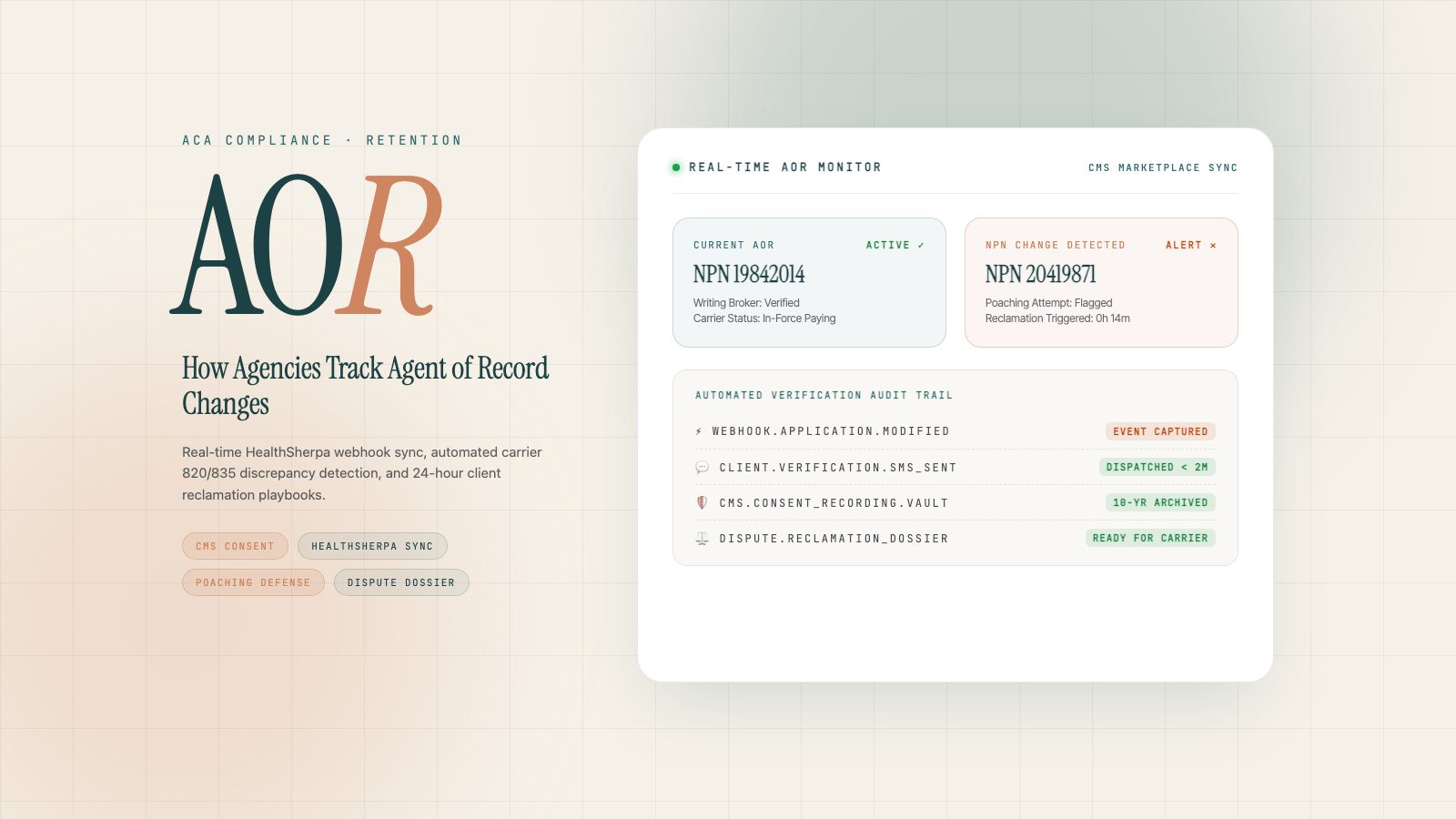
In the ACA individual health insurance market, few operational events are more frustrating or costly than an unauthorized Agent of Record (AOR) switch. An agency invests marketing dollars to acquire a consumer, conducts a comprehensive needs analysis, records compliant consent, and binds the policy on the Marketplace. Weeks later, an offshore call center or lead aggregator runs a deceptive social media campaign promising free gift cards or government subsidies, submits a fraudulent change, and overwrites the agency NPN on the client enrollment.
The financial damage is immediate and compounded: monthly commissions vanish, future renewal rights evaporate, and the agency loses touch with the client. Worse, most agencies discover the loss 30 to 60 days later when reconciling monthly carrier commission statements. At that point, reclaiming the account is difficult and labor-intensive. Protecting your book requires shifting from passive monthly accounting to proactive, real-time AOR telemetry connecting HealthSherpa, your CRM, automated alerts, and instant client verification.
Why Unauthorized AOR Poaching Happens and Why CMS Stepped In
The rapid expansion of the ACA Marketplace, coupled with enhanced premium tax credits, created massive incentives for aggressive lead generators. Deceptive ads often disguise themselves as official portals, prompting consumers to verify their information to claim supplemental cash benefits. Once the consumer submits their name, date of birth, and state, an unscrupulous broker submits an unauthorized application update through direct enrollment portals, replacing the legitimate writing agent without the consumer ever knowing their coverage was altered.
The Centers for Medicare & Medicaid Services (CMS) responded with strict consent and application review regulations, penalizing agents who submit enrollments without prior documented consumer consent. However, regulatory penalties alone cannot monitor your agency portfolio daily. Agency owners must deploy internal technical safeguards to catch AOR discrepancies the moment they occur.
Waiting for carrier commission statements to identify poached policies means operating with a 45-day blind spot. In ACA retention, if you do not contest an unauthorized AOR switch within the first 14 days, the odds of recovering the client drop by more than 70%.
The Three Detection Layers: Building Real-Time AOR Telemetry
A resilient agency does not rely on a single data feed. Instead, it builds three redundant detection layers to monitor every active policy throughout the plan year:
- Layer 1: HealthSherpa Webhook & API Synchronization. HealthSherpa tracks Marketplace policy statuses and application modifications. When configured with real-time webhooks, changes to writing agent NPNs, household status, or plan IDs trigger instant event payloads into your CRM rather than waiting for manual CSV exports.
- Layer 2: Automated Electronic Commission Reconciliation. Uploading carrier 820/835 electronic remittance files into your CRM or AMS enables automated line-by-line matching. When a policy previously paying premiums suddenly drops to zero or displays a commission termination code without an agency cancellation request, an AOR discrepancy alert fires automatically.
- Layer 3: Client Engagement and Delivery Signals. When a poacher alters an enrollment, they frequently modify the consumer email, phone number, or mailing address to intercept carrier correspondence. Automated CRM communication engines detect when high-deliverability SMS or WhatsApp messages suddenly bounce or fail, flagging the profile for immediate human investigation.
Want to connect HealthSherpa webhooks directly to your agency CRM pipeline? Explore HealthSherpa Integration
Legacy Carrier Monitoring vs. Modern Real-Time AOR Tracking
Comparing how traditional paper-and-spreadsheet agencies handle AOR loss versus how technology-first agencies protect their books illustrates the operational gap:
| Operational Capability | Legacy Manual Agency | Modern Consolidated CRM Architecture |
|---|---|---|
| Detection Latency | 30 to 60 days (discovered only upon reconciling monthly carrier PDF statements) | Instant to 24 hours (automated webhook events and nightly carrier delta feeds) |
| Verification Mechanism | Manual phone call to consumer after carrier commissions have already stopped | Automated dual-channel verification ping (SMS/WhatsApp) asking client to confirm any authorized change |
| Evidence Archival for CMS Dispute | Scattered across agent laptops, personal phone recordings, and paper notes | Single-click compliance dossier with 10-year recorded audio consent, IP timestamps, and signed forms |
| Agent Notification | None until the producer notices their monthly commission check dropped | Immediate high-priority alert assigned to the writing agent and compliance supervisor |
| Recovery Rate of Stolen Policies | < 22% (clients are confused or alienated by the time contact is made) | > 78% (rapid outreach reclaims the AOR before the poacher cements the switch) |
“Your Agent of Record status is not just an administrative designation: it is the legal anchor of your entire recurring revenue stream. Agencies that monitor their AOR in real time preserve an average of 8% to 12% more annual revenue than those relying on monthly statements.”
The 4-Step Rapid AOR Reclamation Playbook
When an AOR discrepancy is detected by your system, every hour counts. Follow this structured protocol to verify the situation and restore your agency as writing broker:
Hour 0: Automated Discrepancy Flag
CRM flags NPN change via webhook or commission discrepancy, freezes outgoing automated renewal campaigns, and notifies the assigned producer.
Hour 1 to 4: Client Verification Touchpoint
System sends an automated conversational SMS/WhatsApp prompt asking the client if they authorized a policy revision or speaking with another brokerage.
Hour 24: Direct Producer Phone Consultation
If the client confirms they were misled by an unsolicited call or did not authorize any change, the writing agent initiates a priority recorded call to re-establish relationship trust.
Day 2 to 5: Formal Re-Enrollment & Carrier Dispute
Agent resubmits the compliant enrollment with fresh verified consent, submits an unauthorized switch complaint to CMS, and files an AOR dispute ticket with the carrier partner.
Agency Owner Checklist: Locking Down Your Book Against AOR Loss
Building an ironclad defense against unauthorized broker switches requires clear policies, integrated technology, and proactive client education:
Unauthorized AOR poaching will remain a challenge as long as the ACA Marketplace rewards volume. However, agencies equipped with real-time detection, integrated HealthSherpa synchronization, and instant client verification turn a devastating revenue leak into a manageable operational routine, safeguarding their book of business and protecting their clients from predatory practices.
Next step
Test it with your own workflows.
Start a free trial with a sample of your book, or bring your questions to a conversation with our team.
Sources
- CMS — Consumer consent and application review requirements (FAQ) (opens in a new tab)
- HealthCare.gov — Dates and deadlines (opens in a new tab)
- WhatsApp Business — Getting opt-in (opens in a new tab)
This article is for information only and reflects public information as of its publication date. It is not legal or tax advice. Confirm current rules with CMS, your state exchange and your carriers.