FundamentalsClient JourneySimone Figueira5 min read
Insurance Client Lifecycle: From Lead to Policy, Renewal and Retention
Most agencies treat insurance sales as one-time transactions. Here is the operational framework to master every lifecycle stage from initial contact to multi-year renewals.
In consumer insurance, particularly across health and life lines, the most common strategic mistake is treating policy binding as the finish line. An agency invests heavily in digital media or vendor leads, mobilizes producers to close the application, celebrates the binder, and immediately moves on to the next prospect. Months later, the owner wonders why net policy growth is flat despite writing hundreds of new applications each quarter.
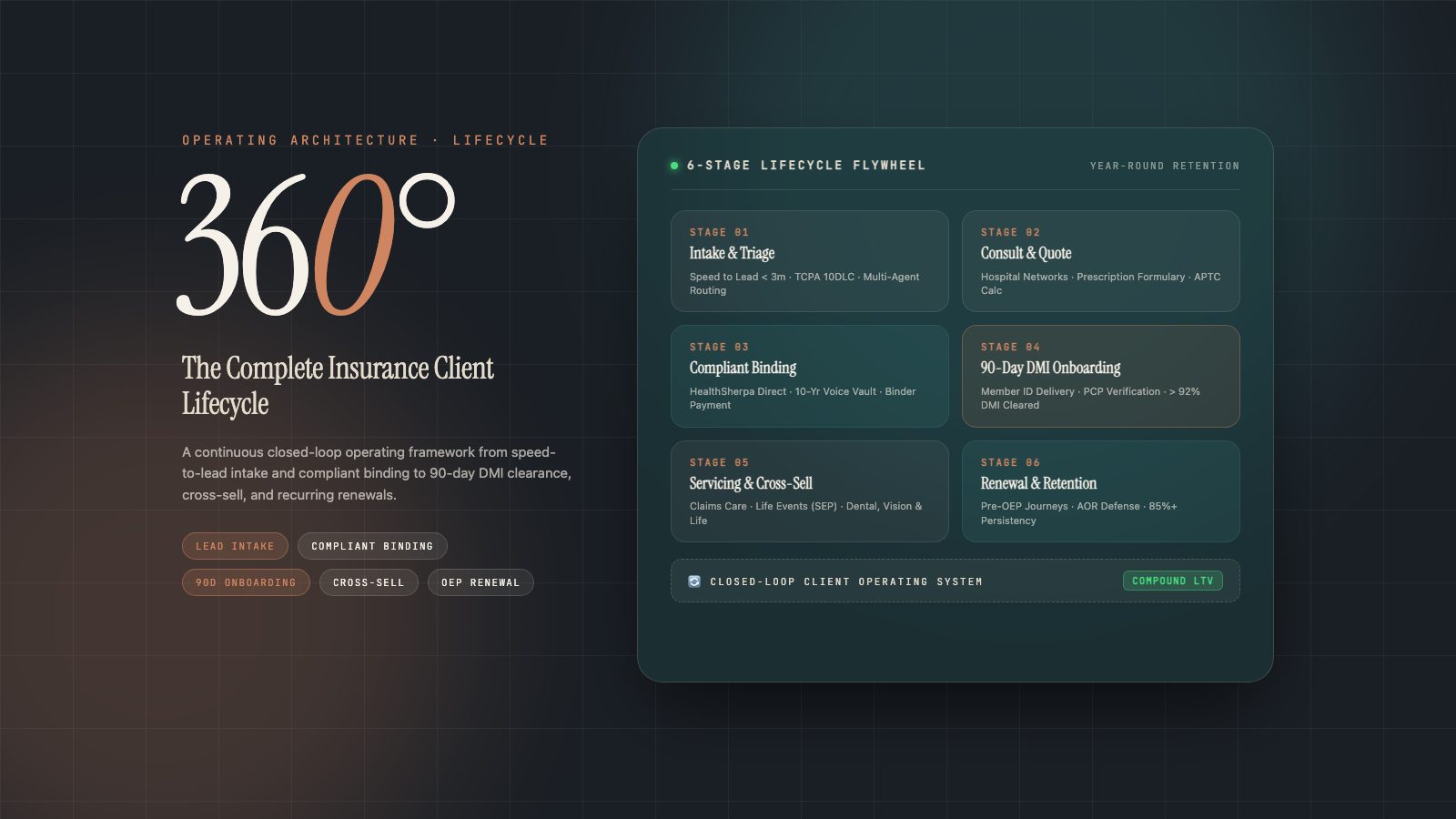
The financial reality of an insurance brokerage is that acquisition is merely an upfront investment; profitability and enterprise valuation are unlocked exclusively through renewals, persistency, and cross-selling. Between 70% and 85% of an agency net lifetime profit is generated after year one. Managing an agency successfully requires viewing the customer relationship not as a linear sales funnel, but as a continuous, closed-loop operating lifecycle spanning six distinct phases.
The 6 Stages of the Insurance Client Lifecycle
A high-retention insurance agency structures its operational workflows, software stack, and producer incentives around six interconnected lifecycle stages:
| Lifecycle Stage | Operational Goal | Key Action / Workflow | Primary Software | Core KPI |
|---|---|---|---|---|
| 1. Lead Intake & Triage | Instant engagement and deduplication | Speed to lead outreach, TCPA consent capture, and agent routing | CRM + Integrated CTI / WhatsApp | Speed to Contact (< 3m), Contact Rate |
| 2. Quoting & Needs Consultation | Accurate plan matching and subsidy calculation | Doctor network check, prescription formulary review, and APTC estimate | Marketplace Quoting Engine + CRM | Lead-to-Quote Conversion, Closing Ratio |
| 3. Application & Compliant Binding | Error-free enrollment and statutory audit trail | Direct marketplace submission, 10-year voice consent archival, binder payment | HealthSherpa / Carrier Portal + Audio Vault | Bind Rate, 100% Consent Compliance |
| 4. Post-Enrollment Onboarding (First 90 Days) | Coverage activation and DMI clearance | Member ID card delivery, PCP verification, and DMI document resolution | Automated CRM Journeys + DMI Pipeline | 90-Day DMI Clearance Rate (> 92%) |
| 5. In-Force Servicing & Cross-Sell | Relationship depth and household protection | Claims support, qualifying life events (SEP), and ancillary bundling | Consolidated Policy CRM | Policies per Household, Monthly Churn |
| 6. Open Enrollment Renewal & Retention | Active plan renewal and AOR defense | Proactive rate comparison, batch renewals, and predatory poaching defense | Renewal Engine + HealthSherpa Webhooks | 13-Month Persistency, OEP Renewal Rate |
In insurance, client acquisition is an investment; client retention is where the return happens. An agency with an 85% persistency rate doubles its book of business in three years with the exact same marketing spend as an agency stuck at 65% persistency.
Stages 1 & 2: Acquisition, Speed to Lead, and Needs Consultation
The lifecycle begins the second a prospect submits an inquiry. In health and life insurance, lead decay happens exponentially: contacting a web lead within three minutes yields up to four times higher close rates than waiting thirty minutes.
- Immediate Multichannel Engagement. High-velocity agencies trigger automated outbound dialer queues and two-way WhatsApp or SMS conversational messages simultaneously, ensuring contact while the prospect is still on their device.
- Automated Deduplication & Household Linking. Checking incoming contact details against existing CRM records prevents agents from competing over the same prospect or splitting household members across multiple accounts.
- Comprehensive Clinical & Financial Discovery. A professional consultation must evaluate more than monthly premium: doctor network participation, prescription formularies, deductible exposure, and accurate modified adjusted gross income (MAGI) calculation are essential to prevent mid-year cancellations.
Want to streamline lead intake, dialer queues, and pipeline stages in one unified workspace? Explore CRMDAY Insurance CRM
Stages 3 & 4: Compliant Binding and the Critical 90-Day DMI Window
Submitting an application through HealthSherpa or a carrier portal is only half the battle. If consumer consent is improperly documented or data matching issues (DMIs) are ignored, coverage will terminate, commissions will be clawed back, and the client relationship will be destroyed before spring.
Day 1: Welcome & Initial Binder Confirmation
Automated WhatsApp/SMS sequence delivering confirmation details, carrier customer portal links, payment verification, and the assigned agent contact card.
Day 7: Card Delivery & Physician Assignment
Follow-up touchpoint confirming the physical insurance card arrived and assisting the member with designating an in-network primary care physician.
Day 14: DMI Inconsistency Clearance
System flags Marketplace data matching issues (income, identity, citizenship) and sends secure mobile upload links before CMS deadlines approach.
Day 45: Preventative Care & Portal Check
Proactive service prompt encouraging the member to schedule zero-copay annual wellness exams and verify that premium payments are set on autopay.
“Most insurance cancellations do not happen because the client disliked their plan. They happen because an unresolved document flag terminated coverage silently, or the client forgot to set up automatic premium payments. The first 90 days decide your entire retention rate.”
Stages 5 & 6: Active Servicing, Cross-Sell, and Open Enrollment Renewal
Clients who hold only a single standalone policy churn at twice the rate of households with multi-line coverage. Mid-year servicing is where an agency builds structural immunity against competitor poaching and sets the foundation for seamless Open Enrollment renewals.
| Client Coverage Profile | Annual Lapse Rate | Average Lifespan (Years) | Estimated Lifetime Revenue |
|---|---|---|---|
| Single ACA Health Plan (No Structured Onboarding) | 28% to 38% annual churn | 1.8 to 2.4 years | $520 to $750 net commission |
| Single ACA Health Plan (Automated Onboarding & DMI Resolution) | 16% to 22% annual churn | 3.2 to 4.1 years | $960 to $1,350 net commission |
| ACA Health + Dental & Vision Bundle | 11% to 15% annual churn | 4.5 to 5.8 years | $1,650 to $2,250 net commission |
| Full Household Bundle (Health + Ancillary + Term Life) | < 8% annual churn | 6.5+ years | $3,200 to $4,800+ net commission |
Why Disconnected Tools Break the Lifecycle Flywheel
When an agency operates on disconnected systems, the lifecycle falls apart at the seams. Leads stall in standalone dialers, policies sit unmonitored in carrier portals, document notices get lost in personal email inboxes, and renewals depend on chaotic spreadsheets. To create a compound growth engine, every stage must share a single data core.
Mastering the complete insurance client lifecycle transforms an agency from a stressful sales treadmill into a compounding recurring revenue asset. When intake, binding, compliance, servicing, and renewals operate within a single intelligent system, your team writes more business, retains more clients, and maximizes enterprise valuation.
Next step
See what a structured insurance operation looks like.
Explore CRMDAY One, the platform we built for independent agents, agencies and FMOs, or keep learning with our evaluation guides.
Sources
- HealthCare.gov — Dates and deadlines (opens in a new tab)
- CMS — Consumer consent and application review requirements (FAQ) (opens in a new tab)
- WhatsApp Business — Getting opt-in (opens in a new tab)
- FCC — Stop unwanted robocalls and texts (opens in a new tab)
This article is for information only and reflects public information as of its publication date. It is not legal or tax advice. Confirm current rules with CMS, your state exchange and your carriers.