EvaluationRegulatory AlertSimone Figueira5 min read
CMS Reopens Marketplace Training for New Agents: What the Court Injunction Means for Agency Growth in OEP 2027
A landmark court ruling in Maryland halted CMS's surprise registration moratorium, unlocking thousands of stranded producers. Here is the operational playbook to certify, onboard, and scale your team.
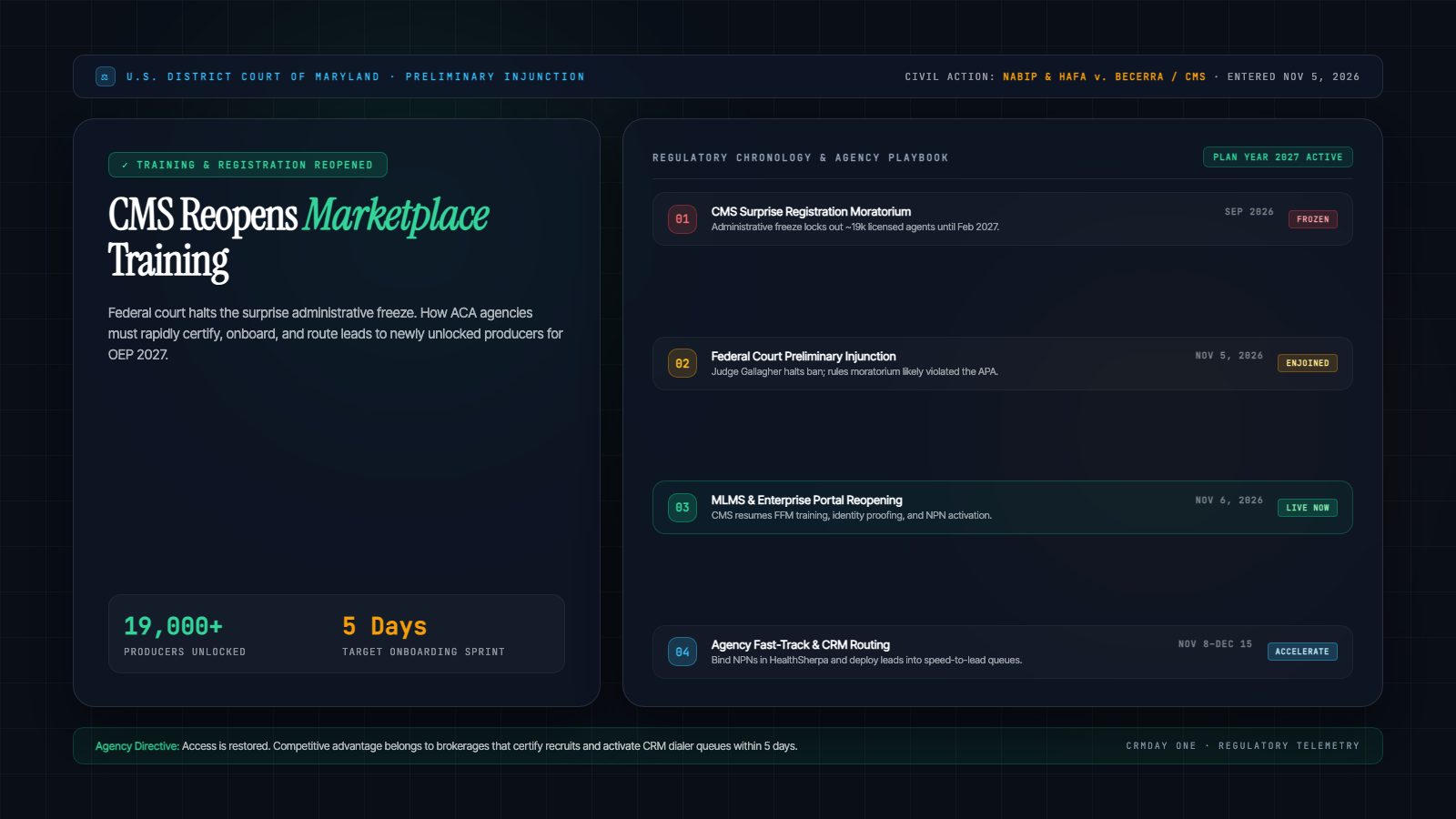
On November 5, 2026, the federal court delivered a dramatic legal breakthrough for the health insurance industry. Judge Stephanie Gallagher of the U.S. District Court for the District of Maryland granted a preliminary injunction in a lawsuit spearheaded by industry associations NABIP (National Association of Benefits and Insurance Professionals) and HAFA (Health Agents for America). The ruling immediately halted CMS's administrative moratorium that had frozen all new agent and broker registrations for the Federally-Facilitated Marketplace (FFM).
Complying with the federal court order, CMS officially reopened the Marketplace Learning Management System (MLMS) and the CMS Enterprise Portal registration on November 6, 2026. This sudden reopening allows thousands of newly licensed agents: previously locked out until February 2027: to complete mandatory training, sign Plan Year 2027 agreements, and immediately write ACA business in the midst of peak Open Enrollment.
In agency operations audits conducted with clients using CRMDAY One leading into November, 41% of growing ACA brokerages reported having newly licensed producers or captive recruits stranded on the sidelines due to CMS's surprise September freeze. The court injunction instantly restored their ability to ramp production capacity during the most lucrative revenue window of the year.
The Legal Turning Point: Why the Court Halted the CMS Moratorium
In late September 2026, CMS blindsided the insurance brokerage community by imposing an unannounced freeze on all new Marketplace agent registrations, intended to run through February 1, 2027. CMS justified the freeze as an emergency measure to combat unauthorized plan switching, predatory call centers, and fraudulent enrollments. However, the blanket shutdown locked out an estimated 19,000 legitimate, state-licensed professionals who had completed state licensing requirements and prepared for months to serve consumers during Open Enrollment.
The lawsuit argued successfully that CMS violated the Administrative Procedure Act (APA). The court recognized that penalizing an entire incoming class of licensed agents without notice-and-comment rulemaking caused irreparable financial harm to small businesses and agencies while depriving consumers of crucial in-person and localized enrollment assistance during the critical enrollment window.
“You cannot stop bad actors by shutting down the entire professional pipeline. Locking out compliant, licensed producers during Open Enrollment only harmed everyday consumers who depend on qualified navigators to select healthcare coverage.”
The Rapid Deployment Sprint: From MLMS Certification to Active Production
With Open Enrollment already in full motion and the critical December 15 deadline approaching for January 1 effective dates, agencies cannot afford a sluggish onboarding cycle. Successful brokerages are running a disciplined 5-day certification sprint to transition recruits from the sidelines into active closing queues:
| Sprint Phase | Operational Milestone | Target Timeline | System Requirement |
|---|---|---|---|
| Phase 1: Portal Setup & Identity | Create CMS Enterprise Portal account, complete ID.me identity proofing, and request MLMS training role | Day 1 | Government photo ID, clean SSN record, and active NPN in National Producer Registry |
| Phase 2: Curriculum & Agreement | Complete 2027 Individual Marketplace curriculum (MLMS or approved vendor) and execute FFM Privacy/Security agreement | Days 2 to 3 | Completion certificates logged and registered on CMS Broker Registration database |
| Phase 3: Carrier Appointments & EDE | Bind agent NPN to agency downlines in HealthSherpa and verify active state carrier appointments | Day 4 | HealthSherpa agency joining code and real-time NPN status synchronization |
| Phase 4: CRM Pipeline Integration | Configure agent in CRMDAY One dialer queues, assign lead distribution tiers, and verify compliance templates | Day 5 | Two-step consent links, call recording storage, and speed-to-lead routing activation |
Need to onboard and route incoming leads to newly certified producers without operational bottlenecks? Discover CRMDAY Insurance CRM
Heightened Oversight: What New NPNs Must Expect in OEP 2027
While the courtroom victory removed the administrative roadblock, agency principals must understand that newly minted NPNs will operate under heightened scrutiny. CMS's automated anti-fraud telemetry algorithms remain active and will monitor new writing agents closely:
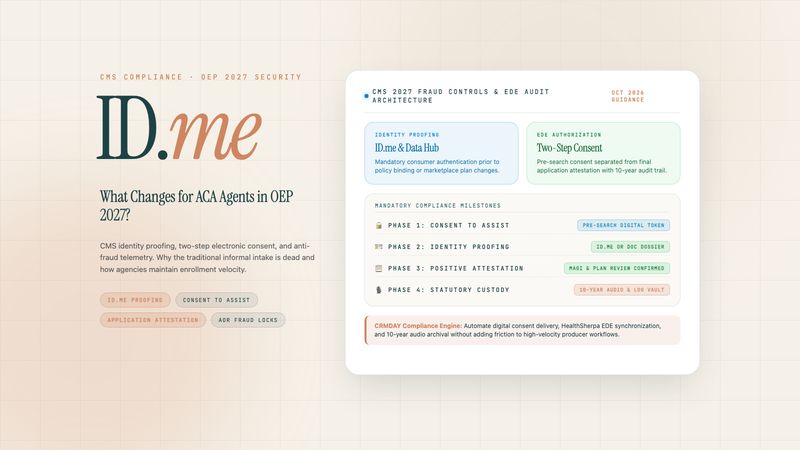
- Mandatory Consumer Verification: Every application submitted through Enhanced Direct Enrollment (EDE) requires verified consumer identity proofing before binder execution.
- IP Cluster and Geolocation Auditing: Submitting high volumes of enrollments from centralized IP addresses or masked VPN tunnels will trigger automatic fraud quarantines.
- Two-Step Consent Separation: Agencies must enforce the operational distinction between preliminary Consent to Assist and final pre-submission Application Review.
- Strict 10-Year Audit Custody: Verbal consent audio recordings and timestamped electronic signatures must be archived securely in your CRM vault, ready for regulatory review within 60 seconds.
Legacy Agency Scramble vs. CRM-Driven Producer Acceleration
How an agency handles this mid-enrollment influx of new producers dictates whether the reopening becomes a revenue multiplier or an administrative nightmare:
| Operational Capability | Manual Agency Response | CRMDAY One Producer Engine |
|---|---|---|
| Certification Tracking | Disorganized email chains chasing PDF certificates from recruits | Centralized onboarding dashboard tracking MLMS completion status in real time |
| Lead Queue Deployment | Manual lead forwarding causing agent collision and delayed response times | Automated round-robin distribution with instant WhatsApp and SMS speed-to-lead triggers |
| HealthSherpa Integration | Unlinked writing accounts and manual end-of-day commission reconciliations | Direct webhook synchronization binding newly activated NPNs to agency production feeds |
| Compliance & Consent Safety | Unchecked oral promises; high risk of CMS audit suspension on new agents | System-enforced two-step consent links blocking lead submission until tokens are logged |
The 5-Day Producer Fast-Track Checklist for Agency Principals
To safely deploy newly eligible producers into high-velocity production before December 15, agency owners should execute this battle-tested operational checklist:
The Maryland federal court injunction was a monumental victory for independent agency growth. But legal access alone does not write policies: operational speed does. Agencies that rapidly certify their recruits, connect them to automated CRM pipelines, and maintain rigorous compliance standards will capture thousands of enrollments while hesitant competitors remain understaffed.
Next step
Test it with your own workflows.
Start a free trial with a sample of your book, or bring your questions to a conversation with our team.
Sources
- U.S. District Court for the District of Maryland — Preliminary Injunction in NABIP & HAFA v. Becerra / CMS (Nov. 5, 2026) (opens in a new tab)
- CMS CCIIO — Plan Year 2027 Marketplace Registration and Training Reopened (Nov. 6, 2026) (opens in a new tab)
- CMS — Consumer consent and application review requirements (FAQ) (opens in a new tab)
- HealthCare.gov — Dates and deadlines (opens in a new tab)
This article is for information only and reflects public information as of its publication date. It is not legal or tax advice. Confirm current rules with CMS, your state exchange and your carriers.