FundamentalsArchitectureSimone Figueira4 min read
HealthSherpa vs. CRM: Why ACA Agencies Often Need Both
HealthSherpa is the premier vehicle for submitting ACA applications. A CRM is the operating system that runs your clients, team, and communications before and after the sale.
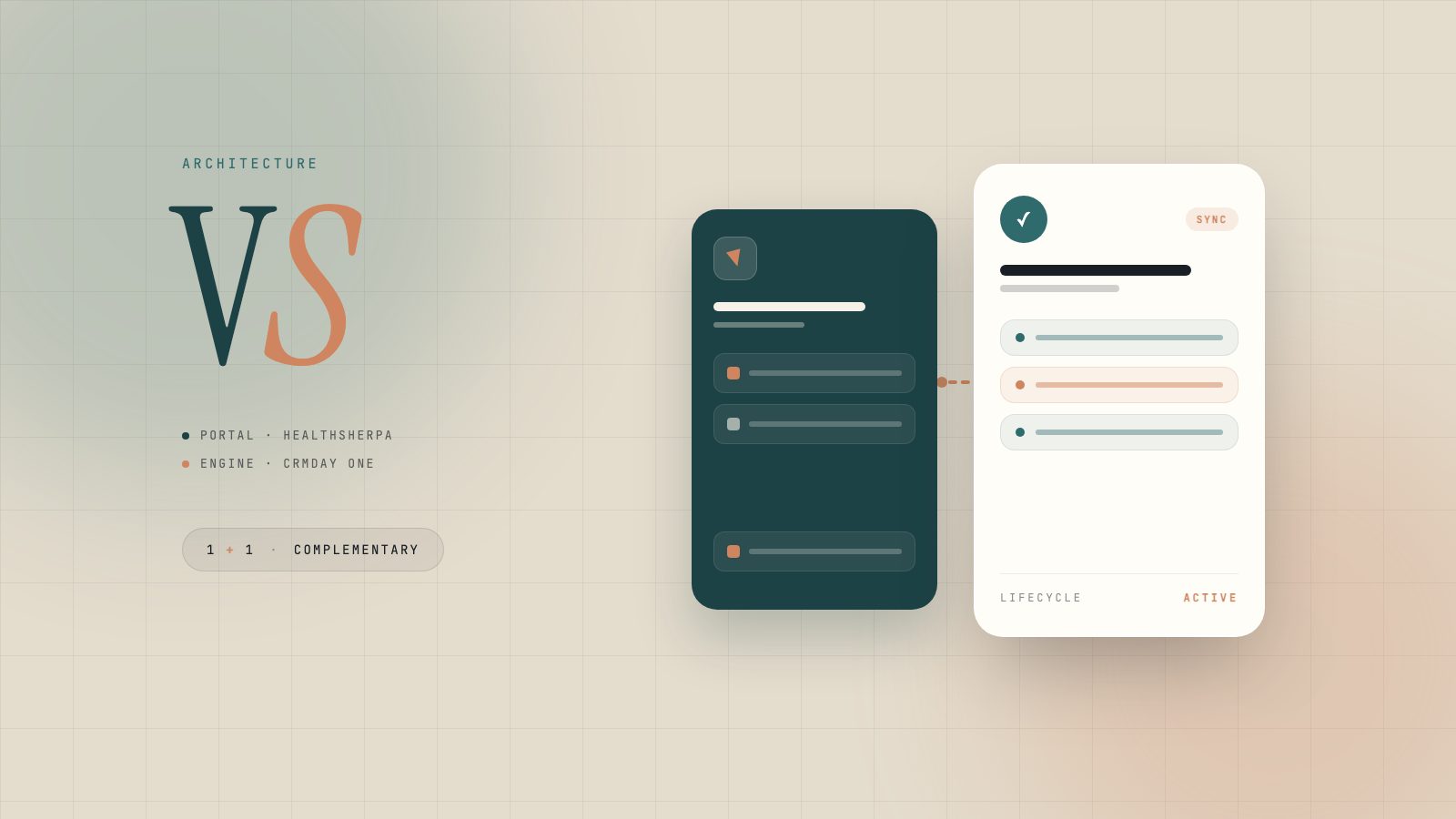
Every year ahead of Open Enrollment, agency owners and independent brokers ask the same question: 'I already quote, submit applications, and see my active policies in HealthSherpa. Why do I need to pay for a separate CRM?' It is an understandable dilemma. HealthSherpa stores client names, plan selections, carrier details, and premium tax credits. At first glance, it looks like a client database.
The confusion stems from conflating an enrollment engine with an operational system. HealthSherpa is an Enhanced Direct Enrollment (EDE) portal: its mission is to connect with CMS and carriers to complete transactions as swiftly and accurately as possible. A CRM, by contrast, governs the relationship across time: capturing unworked leads, automating WhatsApp conversations, enforcing speed to lead, tracking DMI documentation deadlines, and coordinating annual renewals across an entire team.
“HealthSherpa is built to execute the transaction with the Marketplace. A CRM is built to run the agency that owns the relationship.”
The fundamental divide: Transactional portal vs. operating CRM
To understand why high-performing ACA agencies treat both tools as complementary rather than competing, consider how their core operational responsibilities divide:
| Operational area | HealthSherpa (Enrollment Portal) | CRMDAY One (Operating CRM) |
|---|---|---|
| Primary mission | Direct application submission and Marketplace connectivity | End-to-end client lifecycle, team orchestration, and retention |
| When it is used | During the 15 minutes of quoting and submitting the plan | 365 days a year: lead capture, onboarding, service, and renewals |
| Lead acquisition | Starts only after the prospect provides demographic data | Captures paid ads, website inquiries, and inbound calls instantly |
| Communication | Transaction emails and platform notifications | Integrated WhatsApp Business, two-way SMS, calls, and audit trail |
| Post-sale DMIs | Displays pending status and allows document upload | Automated countdown engine with proactive client reminders |
| Team & hierarchies | Individual producer logins and agency reporting | Work distribution, manager queues, and downline commission overrides |
| Cross-selling & Life | Limited to ACA Marketplace and individual health | Multi-policy household records including Life, Dental, and Vision |
Want to see how enrollment data and CRM workflows connect in real time? Explore the HealthSherpa integration
What happens when an agency uses HealthSherpa as its only CRM
Relying solely on an enrollment portal to run a growing book of business creates invisible leaks in your agency's revenue. Here are the five points where the single-tool approach typically breaks down:
- 01The lead black hole. Prospects from social media campaigns, referrals, and landing pages cannot live in HealthSherpa until an application begins. Without a CRM, unconverted leads languish in personal inboxes, spreadsheets, or WhatsApp chats without follow-up reminders or speed to lead tracking.
- 02Disconnected conversations. When agents communicate with policyholders using personal cell phones or unlinked messaging apps, client history is scattered. If an agent leaves your agency, their entire relationship history and customer goodwill walk out the door with them.
- 03Passive DMI tracking. HealthSherpa flags when a client has an income or identity Data Matching Issue, but it will not run an automated multi-step campaign via WhatsApp and SMS to chase the required tax returns or pay stubs before the 90-day cancellation deadline.
- 04Manual renewal chaos. Come November 1, an agency using only HealthSherpa must manually review hundreds or thousands of records to identify who had premium increases or carrier exits. An operational CRM segments the book automatically and triggers renewal outreach before Open Enrollment even starts.
- 05Zero visibility into downline overrides. For agency networks and FMOs, HealthSherpa records who wrote the application, but it does not calculate multi-tier override splits or manage hierarchical reporting across sub-agencies.
HealthSherpa makes your producers lightning fast during the 15 minutes of application entry. An operating CRM makes your agency profitable across the other 364 days of the year.
How both platforms work together in high-volume agencies
Rather than forcing one system to do a job it was never engineered for, modern insurance operations connect both tools into a continuous operational pipeline:
- Step 1: Lead ingestion and instant response. Inbound inquiries land directly in the CRM. The platform assigns the lead to an available producer and triggers an automated greeting within 60 seconds.
- Step 2: Contextual quoting. The producer qualifies the household, reviews family members, and launches the quoting workspace with applicant details already structured.
- Step 3: Direct enrollment via HealthSherpa. The producer submits the application through HealthSherpa, benefiting from its rapid carrier submission and marketplace approval speed.
- Step 4: Automated policy sync and lifecycle management. As soon as the application is confirmed, the policy details, effective dates, and pending DMIs flow back into CRMDAY One without manual export. The CRM takes over client onboarding, document collection, and renewal scheduling.
Can an independent broker survive on HealthSherpa alone?
The answer depends entirely on your business model and operational volume:
- When HealthSherpa alone is sufficient: If you are a solo producer writing fewer than 100 policies a year, running zero paid advertising, and managing all customer service yourself without assistants, HealthSherpa plus a simple task list can get you through your first season.
- When a dedicated CRM becomes mandatory: The moment you employ a second producer or customer service assistant, run digital campaigns, manage downline agents, or exceed 200 active policyholders, operating without a CRM costs more in lost renewals and lapsed DMIs than the software subscription itself.
Ready to structure your agency stack for the upcoming season? Explore CRMDAY One for ACA & Health
Next step
See what a structured insurance operation looks like.
Explore CRMDAY One, the platform we built for independent agents, agencies and FMOs, or keep learning with our evaluation guides.
Sources
- HealthCare.gov — Dates and deadlines (opens in a new tab)
- HealthCare.gov — How do I resolve a data matching issue? (opens in a new tab)
- CMS — Consumer consent and application review requirements (FAQ) (opens in a new tab)
This article is for information only and reflects public information as of its publication date. It is not legal or tax advice. Confirm current rules with CMS, your state exchange and your carriers.