FundamentalsArchitectureSimone Figueira6 min read
Insurance Agency Technology Stack 2027: CRM, AMS, Dialer, SMS, AI and Enrollment
A complete guide to the modern insurance agency tech stack: dissecting the 6 essential software layers, the CRM vs. AMS distinction, and reference architectures from solo producers to 50+ agent FMO networks.
The average American health and life insurance agency runs on 7 to 11 disconnected software subscriptions: a generic sales CRM, a legacy agency management system (AMS), a standalone cloud dialer, a third-party SMS platform, specialized ACA quoting tools, and endless spreadsheets to calculate downline commission overrides. Agency principals spend between $400 and $900 per producer each month on software, yet their agents spend up to 40% of their day manually copy-pasting client data between incompatible browser tabs.
Heading into Open Enrollment 2027, the traditional 'duct-tape-and-Zapier' tool stack is breaking under three compounding pressures: stricter CMS consumer consent and call recording mandates, carrier API lockouts for non-compliant aggregators, and the urgent need for sub-minute lead response times. Winning agencies are replacing fragmented point solutions with unified operating platforms. This guide provides the complete architectural blueprint for the 2027 insurance technology stack.
“Software does not produce policies: licensed agents do. When your technology stack forces an agent to switch logins six times to complete a single enrollment, your agency is subsidizing operational friction with your own profit margins.”
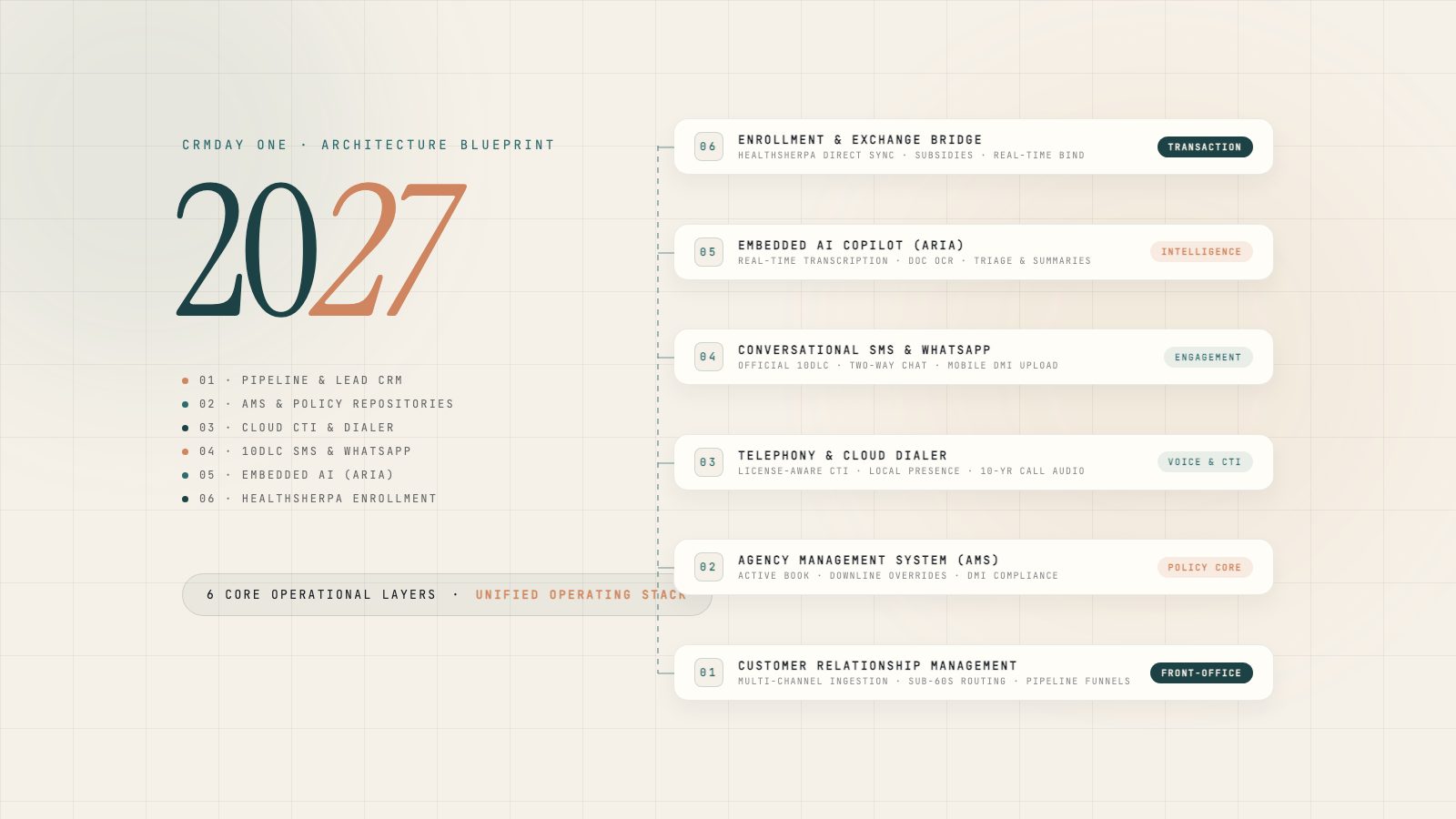
The 6 Core Layers of the Modern Insurance Technology Stack
A resilient agency architecture must cover the complete policyholder journey without data silos. Every modern agency stack requires six functional layers working in continuous synchronization:
- 1. Customer Relationship Management (CRM). The commercial engine: manages lead acquisition, pipeline stages, multi-channel lead qualification, and speed to lead. It tracks contact attempts, scheduling, and front-end producer productivity.
- 2. Agency Management System (AMS). The policy and operational book of record: stores carrier policies, effective dates, premium breakdown, dependents, Marketplace application IDs, and downline commission override hierarchies.
- 3. Telephony and Cloud Dialer (CTI). Inbound/outbound calling infrastructure: handles license-aware call routing, local presence caller ID, automated voicemail drops, and FCC/TCPA compliant call recording with dual-channel audio storage.
- 4. Conversational WhatsApp and Two-Way SMS. High-engagement mobile messaging: operates under 10DLC registration, supporting instant automated intake, document photograph upload, and multi-channel DMI reminder cadences with delivery tracking.
- 5. Embedded Artificial Intelligence (AI Copilot). Context-aware agent assistance: provides real-time call transcription, automatic summary generation, speech-to-intent analysis, and automated OCR for tax 1040 and wage documentation.
- 6. Quoting and Direct Enrollment Engine. Regulatory transactional bridge: direct connection to HealthCare.gov and state-based exchanges (typically via HealthSherpa API integration) for subsidy calculation, carrier plan comparisons, and instant submission.
CRM vs. AMS: The Critical Architectural Distinction Agencies Misunderstand
One of the most expensive mistakes agency owners make is confusing a sales CRM with an Agency Management System, or attempting to force one tool to perform the role of the other without understanding their fundamental data models:
- The CRM is lead-centric and pipeline-driven. It is optimized for velocity: rapid contact, conversion funnels, response times, and sales qualification. Once a deal is won, generic CRMs treat the transaction as finished.
- The AMS is policy-centric and lifecycle-driven. It tracks complex multi-year relationships: carrier policy numbers, annual renewals, APTC adjustments, dependent coverage, commission statement reconciliations, and regulatory compliance logs.
- The cost of disconnection. When CRM and AMS are separate databases linked by fragile third-party webhooks, agents must re-enter customer data upon policy submission. DMIs identified in the AMS fail to notify the sales agent, and renewal opportunities slip away unnoticed.
- The unified operating platform model. Modern systems like CRMDAY One merge CRM velocity with AMS depth in a single relational data model, ensuring that the sales lead seamlessly becomes the permanent policyholder record.
Looking for an operating system that unifies CRM pipeline velocity with full AMS policy depth? Explore CRMDAY One
Stack Architectures by Agency Size: Solo, Growth and Enterprise Networks
Technology stack requirements evolve dramatically as an agency scales from an independent producer to a multi-tiered agency network. Here is how high-performing organizations structure their stack at each growth tier:
- Tier 1: Solo Independent Agent (1 Producer). Priorities: Zero overhead, low complexity, mobile agility. Architecture: A unified insurance CRM with native telephony, built-in SMS, and direct HealthSherpa sync. Eliminates third-party middleware and keeps total tech spend under $200/month.
- Tier 2: Growth Agency (5 to 25 Producers). Priorities: Lead distribution, speed to lead, license routing, and DMI team management. Architecture: Centralized dialer with CTI screen pops, state license round-robin routing, shared compliance inbox for document collection, and automated binder payment chasing.
- Tier 3: FMO / Agency Network (50+ Producers across Multiple Downlines). Priorities: Hierarchical commission override splits, downline performance visibility, sub-agency permission partitioning, and enterprise-grade regulatory audit logging.
Agencies operating five or more disconnected software tools lose an estimated 11 hours per agent each week to manual data re-entry, reconciliation, and troubleshooting broken webhook integrations.
Compliance by Design: CMS, TCPA and Carrier Standards in 2027
In 2027, technology stack architecture is an agency's first line of regulatory defense. Disjointed tools make compliance audit readiness virtually impossible when regulators inspect consumer consent:
- 10-Year CMS Call Recording Retention. CMS regulations mandate that all enrollment-related telephone calls be recorded in their entirety and stored in an immutable, easily retrievable archive for a minimum of 10 years. Fragmented VoIP dialers with 30-day storage limits expose agencies to severe carrier sanction.
- TCPA and 10DLC Mobile Messaging Compliance. Unregistered generic SMS platforms face carrier filtering rates above 35%. Modern stacks require native 10DLC brand registration, automated opt-in/opt-out logging, and timestamped digital consent capture.
- Carrier Credential & Marketplace Security Standards. Sharing agent logins or routing customer records across insecure consumer messaging apps violates HIPAA and CMS security guidelines. All customer document exchange must flow through encrypted, permission-controlled portals.
Consolidated vs. Fragmented Tool Stack: The 2027 Evaluation Matrix
Comparing the operational reality of running six disconnected subscriptions versus a consolidated insurance operating platform across key performance dimensions:
| Stack Layer | Fragmented Approach (Traditional SaaS) | Unified Approach (CRMDAY One) | Average Monthly Cost / Seat | Operational Latency & Risk |
|---|---|---|---|---|
| 1. Sales CRM | Generic CRM (HubSpot, GoHighLevel) | Native insurance pipeline & custom fields | $50 to $150 / seat | Lacks household models and APTC calculations |
| 2. AMS & Policy Record | Separate legacy AMS (AgencyBloc, HawkSoft) | Integrated policy, dependent & binder tracking | $75 to $200 / seat | Requires double data entry after every enrollment |
| 3. Telephony & Dialer | Third-party VoIP (RingCentral, Kixie) | Built-in CTI dialer with license-aware routing | $65 to $140 / seat | Call recordings not tied to policy audit trails |
| 4. SMS & WhatsApp | Standalone messaging tool or generic Twilio | Native 10DLC two-way conversational inbox | $30 to $80 / seat | High message filtering rate; disconnected DMI upload |
| 5. AI & Copilot | Generic ChatGPT wrappers or third-party bots | ARIA insurance copilot (OCR, summaries, triage) | $40 to $100 / seat | Hallucinates CMS rules; lacks client context |
| 6. Enrollment Bridge | Manual re-entry on carrier/exchange portals | Bi-directional HealthSherpa webhook sync | $0 to $50 / seat | Slow turnaround; missed Marketplace updates |
Migration Roadmap: How to Consolidate Your Agency Stack in 4 Phases
Consolidating your agency stack does not require halting current operations. High-performing agencies execute a disciplined, phased transition over a 30 to 45 day window:
- 01Phase 1: Database Audit and Lead Engine Unification (Days 1–10). Export active policyholder lists and historic leads. Normalize phone numbers into E.164 format. Configure lead ingestion webhooks and license-aware routing rules.
- 02Phase 2: Telephony, Messaging and Compliance Setup (Days 11–20). Port or provision agency phone numbers. Complete 10DLC brand registration for high-deliverability SMS. Activate compliant call recording and digital consent capture forms.
- 03Phase 3: HealthSherpa and Carrier Integration (Days 21–30). Connect the HealthSherpa bi-directional sync. Run test enrollments to verify automatic policy creation, binder status flags, and DMI ticket generation.
- 04Phase 4: Commission Reconciliation and Team Enablement (Days 31–45). Import carrier commission statements, configure agent commission contracts and override hierarchies, and train producers on the unified operating interface.
Next step
See what a structured insurance operation looks like.
Explore CRMDAY One, the platform we built for independent agents, agencies and FMOs, or keep learning with our evaluation guides.
Sources
- CMS — Consumer consent and application review requirements (FAQ) (opens in a new tab)
- HealthCare.gov — Dates and deadlines (opens in a new tab)
- FCC — Stop unwanted robocalls and texts (opens in a new tab)
- WhatsApp Business — Getting opt-in (opens in a new tab)
This article is for information only and reflects public information as of its publication date. It is not legal or tax advice. Confirm current rules with CMS, your state exchange and your carriers.