EvaluationRetentionAlex Mariano3 min read
From renewal list to renewal engine: designing year-round retention
A renewal list tells you who expires. A renewal engine tells your team what to do about it, every month.

Most agencies treat renewals as a list: export who expires next month, split it among agents, call as many as possible. It works until volume grows or a season like Open Enrollment compresses everything into a few weeks. A renewal engine is different: it runs every month, starts early and turns data into assigned work automatically.
The four parts of the engine
| Part | What it does |
|---|---|
| Segments | Groups clients by line, renewal month, risk and value |
| Triggers | Starts work at a set time before renewal, or when something changes |
| Owners | Every renewal has a person responsible and a backup |
| Rhythm | A monthly review of what renewed, what lapsed and why |
Triggers worth automating
- 90 days out: review task for high-value or at-risk clients.
- 60 days out: message confirming contact details and inviting questions.
- 30 days out: decision follow-up with the assigned agent.
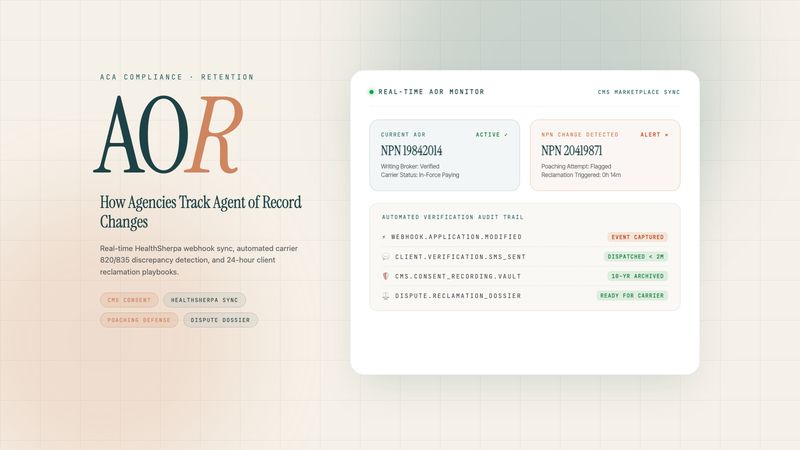
- Portfolio change: an agent-of-record change or cancellation creates an immediate retention task.
- Life change reported: new job, new baby or a move triggers a coverage review.
Health and ACA books have their own seasonal rhythm on top of this. Read the Open Enrollment 2027 renewal playbook
Measure the engine monthly
- 01Renewal rate by line and by agent.
- 02Share of renewals with a contact before the due date.
- 03Lapses with a recorded reason.
- 04Cross-sell conversations opened during renewal reviews.
If a renewal only gets attention in its last week, the engine isn't running; your team is.
Next step
Test it with your own workflows.
Start a free trial with a sample of your book, or bring your questions to a conversation with our team.