EvaluationOperationsAlex Mariano9 min read
Insurance Agency Automation: 25 Workflows You Can Automate
A comprehensive operational taxonomy of 25 mission-critical insurance agency workflows: triggers, conditions, automated actions, and guardrails across the entire policy lifecycle.
Most insurance agencies do not suffer from a lack of leads or closing talent. They suffer from operational friction: manual document chasing, missed follow-ups, fragmented carrier logins, neglected Marketplace Data Matching Issues (DMIs), and commission reconciliation performed line-by-line on disconnected spreadsheets. In high-volume sectors like ACA and Life, operational latency directly erodes margins, causes preventable policy terminations, and caps production capacity per producer.
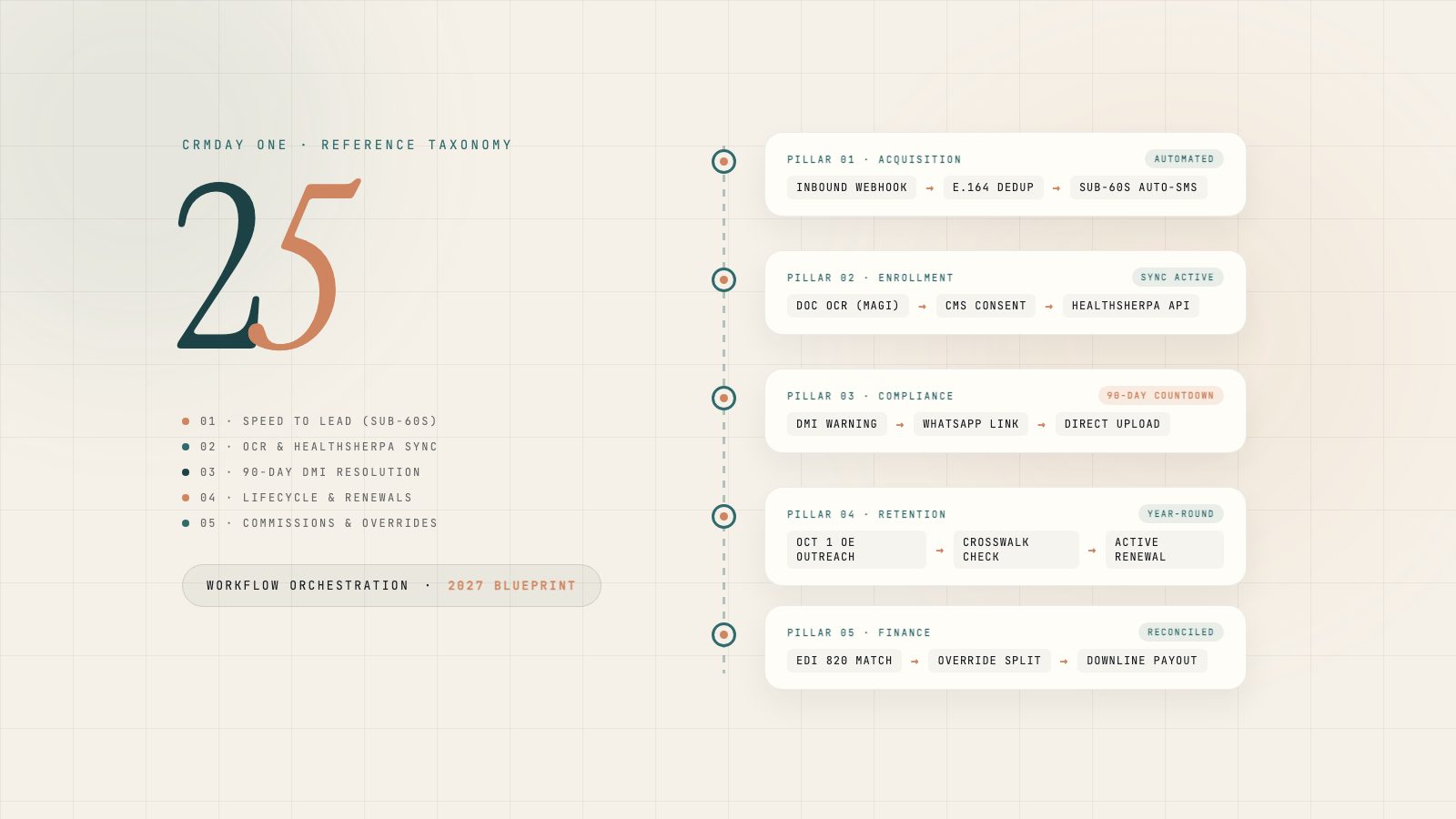
True agency automation is not a brittle web of generic Zapier triggers that break during Open Enrollment traffic surges. It is an integrated operational backbone where triggers, regulatory guardrails (CMS, TCPA), carrier integrations, and two-way messaging work synchronously. Below is a comprehensive reference blueprint of 25 mission-critical workflows top-performing agencies automate across five operational pillars.
“Agency automation is not about eliminating the licensed producer. It is about automating every repetitive operational friction point so the agent spends 100% of their day advising clients and closing policies.”
Pillar 1: Lead Acquisition, Speed to Lead and Routing (Workflows 1–5)
The first minutes after an inbound inquiry dictate closing rates. In high-intent ACA and life insurance marketing, converting leads requires sub-minute contact combined with strict regulatory compliance and capacity-aware agent assignment.
- 1. Instant Multi-Channel Lead Ingestion and Deduplication. Trigger: Lead arrives via webhook (Facebook Lead Ad, Google, landing page, aggregator). Action: Ingest within 200ms, normalize phone/email into E.164 format, check database for existing active client or duplicate inquiry in the last 90 days. If duplicate, route to original writing agent; if new, initiate immediate distribution.
- 2. Sub-60-Second Automated WhatsApp/SMS Qualification. Trigger: Valid new lead ingestion. Action: Dispatch conversational introductory message with dual-language greeting and 1-to-1 opt-in confirmation under TCPA/10DLC rules. AI assistant asks two quick qualifying questions (state of residence, household size) before handing off to an available producer.
- 3. Dynamic License- and Language-Aware Producer Routing. Trigger: Lead verified with state and primary language. Action: Route lead via round-robin only among producers who hold active resident/non-resident licenses in that specific state, speak the prospect's native language, and have an active status in the dialer.
- 4. Missed Inbound Call Instant Auto-Text & Scheduling. Trigger: Unanswered inbound call from a prospect or customer during or after business hours. Action: Immediate SMS within 45 seconds: 'Sorry we missed your call! We are with a client. Reply with 1 to request an immediate callback or pick a time on our calendar [link].' Automatically creates an open task for the assigned agent.
- 5. 30/60/90-Day Cold Lead Re-Engagement Drip. Trigger: Lead marked 'Unreached' or 'Contacted - Not Closed' after initial 14-day sales blitz. Action: Automated bi-weekly check-in via SMS and email with educational value (e.g. SEP eligibility trigger checklist, subsidy change alert). If prospect replies, lead status resets to 'Hot Re-Engaged' and alerts the assigned agent.
Pillar 2: Quoting, Eligibility and Enrollment Orchestration (Workflows 6–10)
Manual data entry during quoting introduces costly errors. Automating document extraction, subsidy calculation, and carrier submission reduces enrollment turnaround from 45 minutes to under 10 minutes.
- 6. Household Intake & Document OCR Extraction. Trigger: Prospect uploads driver's license, paystub, or prior year 1040 tax return via secure portal or WhatsApp. Action: OCR extracts household size, date of birth, SSN, and projected annual modified adjusted gross income (MAGI) directly into the CRM client profile without manual retyping.
- 7. Pre-Enrollment APTC & FPL Tier Calculation. Trigger: Household size and verified estimated income entered in the CRM. Action: Automated calculator determines household percentage of the Federal Poverty Level (FPL), identifies zero-dollar Silver CSR (Cost-Sharing Reduction) eligibility, and flags potential Medicaid gap scenarios.
- 8. Multi-Carrier Side-by-Side Comparison Generator. Trigger: Agent selects target county and doctor/medication preferences. Action: CRM queries carrier APIs and generates a personalized, branded digital comparison link sent to the client via SMS, highlighting deductible, out-of-pocket maximum, and in-network primary care doctors.
- 9. Digital CMS Consumer Consent & Scope of Appointment Capture. Trigger: Producer transitions prospect from quoting to application stage. Action: Automated dispatch of compliant SMS/WhatsApp consent form. Captures timestamped digital signature, IP address, exact disclosure text, and audio recording reference before submission to the Marketplace.
- 10. Bi-Directional HealthSherpa / Marketplace Sync. Trigger: Policy enrolled or modified in HealthSherpa. Action: Webhook instantly synchronizes Marketplace Application ID, plan name, net premium after APTC, policy start date, and binder status back into the CRM profile.
Looking for an operating system with native HealthSherpa sync, ARIA copilot, and built-in insurance workflows? Explore CRMDAY One
Pillar 3: Post-Enrollment Servicing, DMIs and Payment Protection (Workflows 11–15)
The sale is only complete when the first payment clears and Marketplace verification requirements are fully met. Automating document reminders and payment verifications stops silent churn before it starts.
- 11. Automated Data Matching Issue (DMI) Ticket Generation. Trigger: Marketplace sync returns an active DMI (income discrepancy, citizenship, lawful presence, or incarceration status). Action: CRM calculates the exact 90-day deadline, creates a high-priority ticket, and assigns it to the agency's dedicated compliance desk.
- 12. Escalating Multi-Channel Document Request Cadence. Trigger: Open DMI ticket on days 5, 30, 60, 75, and 85 before the deadline. Action: Automated WhatsApp and SMS sequence reminding the client of the exact required document (W-2, 1040, passport) with a secure, one-click upload link directly from their smartphone.
- 13. Document Submission Receipt & Client Confirmation. Trigger: Customer uploads requested proof. Action: System verifies file readability, marks the DMI ticket 'Pending Review', notifies the servicing agent to upload to the Marketplace portal, and sends the customer an instant confirmation: 'Document received! We are submitting it to the Marketplace.'
- 14. Carrier Binder Payment Verification Alert. Trigger: 5 business days after enrollment with no carrier payment confirmation on file. Action: Automated SMS and email reminder with the carrier's direct payment phone line and portal link: 'Your coverage starts on [Date]. Complete your initial payment to activate your insurance card.'
- 15. Special Enrollment Period (SEP) Document Submission Tracker. Trigger: Off-season enrollment submitted under a Qualifying Life Event (marriage, relocation, loss of coverage). Action: 30-day countdown timer initiated with automated prompts requesting supporting proof of loss of coverage, preventing retroactive policy cancellation.
Agencies that automate DMI document collection and binder payment alerts recover an average of 14% to 18% of enrolled policies that would otherwise terminate within the first 90 days.
Pillar 4: Retention, Renewals and Grace Period Rescue (Workflows 16–20)
Customer lifetime value in health and life insurance depends on cumulative renewals. Replacing year-end panic with automated year-round engagement turns a 65% retention rate into 88%+.
- 16. 90-Day Onboarding & Primary Care Physician Setup. Trigger: 90 days post-effective date. Action: Automated friendly message asking if the customer received their member ID cards and whether they need assistance finding an in-network doctor, cementing agency relationship and building long-term loyalty.
- 17. Pre-Open Enrollment Pipeline Warm-Up (October 1). Trigger: System calendar reaches October 1. Action: Automated personalized outreach to the agency's entire active book: 'Open Enrollment for 2027 starts in 30 days. Let us verify if your doctors, income, or household size changed so we can prepare your renewal package.'
- 18. Carrier Discontinuation / Crosswalk Alert. Trigger: CMS plan landscape file loaded into CRM showing client's current plan will be discontinued or premium will increase by >15%. Action: Tags affected policies as 'High-Risk Crosswalk' and generates pre-selected alternative plan recommendations for the agent to review.
- 19. Active vs. Passive Renewal Confirmation. Trigger: Client reviews renewal options and confirms satisfaction with current coverage. Action: Captures client's written consent to auto-renew without modification, records the confirmation in the CRM audit trail, and marks the record 'Renewed 2027'.
- 20. Grace Period / Delinquency Rescue Sequence. Trigger: Carrier webhook or statement flags policy status as 'In Grace Period' or 'Premium Past Due'. Action: Emergency WhatsApp/SMS sequence alerted to client and assigned producer with direct payment link, rescuing the policy before the 90-day grace period expires.
Pillar 5: Back-Office, Commission Accounting and Compliance (Workflows 21–25)
Operating an agency or agency network requires meticulous financial controls. Automating commission matching, override splits, and compliance audits protects cash flow and agency equity.
- 21. Carrier Commission Statement Parsing & Discrepancy Flagging. Trigger: Electronic monthly commission file uploaded (Excel, CSV, EDI 820). Action: System matches carrier policy IDs against CRM active records. Automatically flags unlisted active policies, zero-commission entries, and chargebacks for operational review.
- 22. Hierarchical Downline Override Calculation. Trigger: Monthly agency commission batch finalized. Action: CRM calculates contract split percentages for writing agents, team leaders, and FMO overrides based on configured tier hierarchies, generating downloadable payout statements.
- 23. Agent State License & E&O Expiration Warning System. Trigger: 60, 30, and 15 days prior to an internal producer's license or Errors & Omissions policy expiration date. Action: Automated notifications to the producer and agency operations manager. Suspends automated lead routing in that state if renewal is not confirmed by deadline.
- 24. Continuous CMS/TCPA Regulatory Audit Archival. Trigger: Any outbound communication (call recording, SMS, email, signed consent form). Action: Automatically logs message metadata, delivery receipts, opt-out status, and voice recording links into an immutable, search-indexed audit log for 10-year CMS compliance.
- 25. Daily Executive Operations Snapshot. Trigger: Monday through Friday at 7:00 AM. Action: Dispatches an automated executive briefing via Slack/email summarizing inbound lead volume, speed-to-lead average, open DMI tickets, binder payment clearance rate, and active policy counts by carrier.
The Automation Blueprint: Priority Matrix and Implementation ROI
Agencies should not attempt to build all 25 automations on day one. Prioritize based on operational leverage and immediate revenue protection:
| Pillar | Workflows | Complexity | Tech Stack Required | Impact on Revenue / Margin |
|---|---|---|---|---|
| 1. Lead Acquisition & Speed | Workflows 1–5 | Low to Medium | CRM + WhatsApp/SMS API + Dialer | +25% to +40% lead-to-appointment conversion |
| 2. Quoting & Enrollment | Workflows 6–10 | Medium to High | OCR Engine + HealthSherpa Sync + CMS Consent | -60% quoting turnaround; 0 missing consent audits |
| 3. Post-Enrollment & DMIs | Workflows 11–15 | Medium | Ticket Workflow + Automated Document Ingestion | 14% to 18% reduction in early policy terminations |
| 4. Retention & Renewals | Workflows 16–20 | Medium | Lifecycle Engine + Carrier Crosswalk Sync | Boosts renewal rate from ~65% to 85%+ |
| 5. Commissions & Back-Office | Workflows 21–25 | High | Commission Parser + Multi-Tier Hierarchy Split | Recovers 3% to 6% in missing carrier commission fees |
How to Transition from Disconnected Tools to Unified Agency Orchestration
Most agencies run into an 'automation ceiling' when connecting disparate SaaS tools with third-party webhooks. As volume scales during Open Enrollment, webhooks drop payloads, fields desynchronize, and error monitoring becomes a full-time job. A structured transition follows three clear milestones:
- 01Phase 1: Inbound Lead Velocity & Legal Consent (Weeks 1–2). Establish sub-minute automated initial responses, TCPA/10DLC compliance logging, and license-aware agent distribution. This delivers immediate, measurable top-line revenue lift.
- 02Phase 2: Enrollment Sync & DMI Protection (Weeks 3–4). Connect HealthSherpa, eliminate double entry, and configure automated document collection sequences for data matching issues to safeguard your book before year-end.
- 03Phase 3: Lifecycle Retention & Commission Intelligence (Weeks 5–6). Roll out automated year-round touchpoints, October Open Enrollment warm-ups, carrier commission statement reconciliations, and executive KPI reporting.
Next step
Test it with your own workflows.
Start a free trial with a sample of your book, or bring your questions to a conversation with our team.
Sources
- CMS — Consumer consent and application review requirements (FAQ) (opens in a new tab)
- HealthCare.gov — How do I resolve a data matching issue? (opens in a new tab)
- FCC — Stop unwanted robocalls and texts (opens in a new tab)
- WhatsApp Business — Getting opt-in (opens in a new tab)
This article is for information only and reflects public information as of its publication date. It is not legal or tax advice. Confirm current rules with CMS, your state exchange and your carriers.