FundamentalsStrategyAlex Mariano6 min read
From tool stack to operating platform: how insurance agencies outgrow their software patchwork
A CRM, a dialer, a texting app, a quoting site, an e-signature tool, a commission spreadsheet. Each one made sense when it was bought. Together, they became the problem.
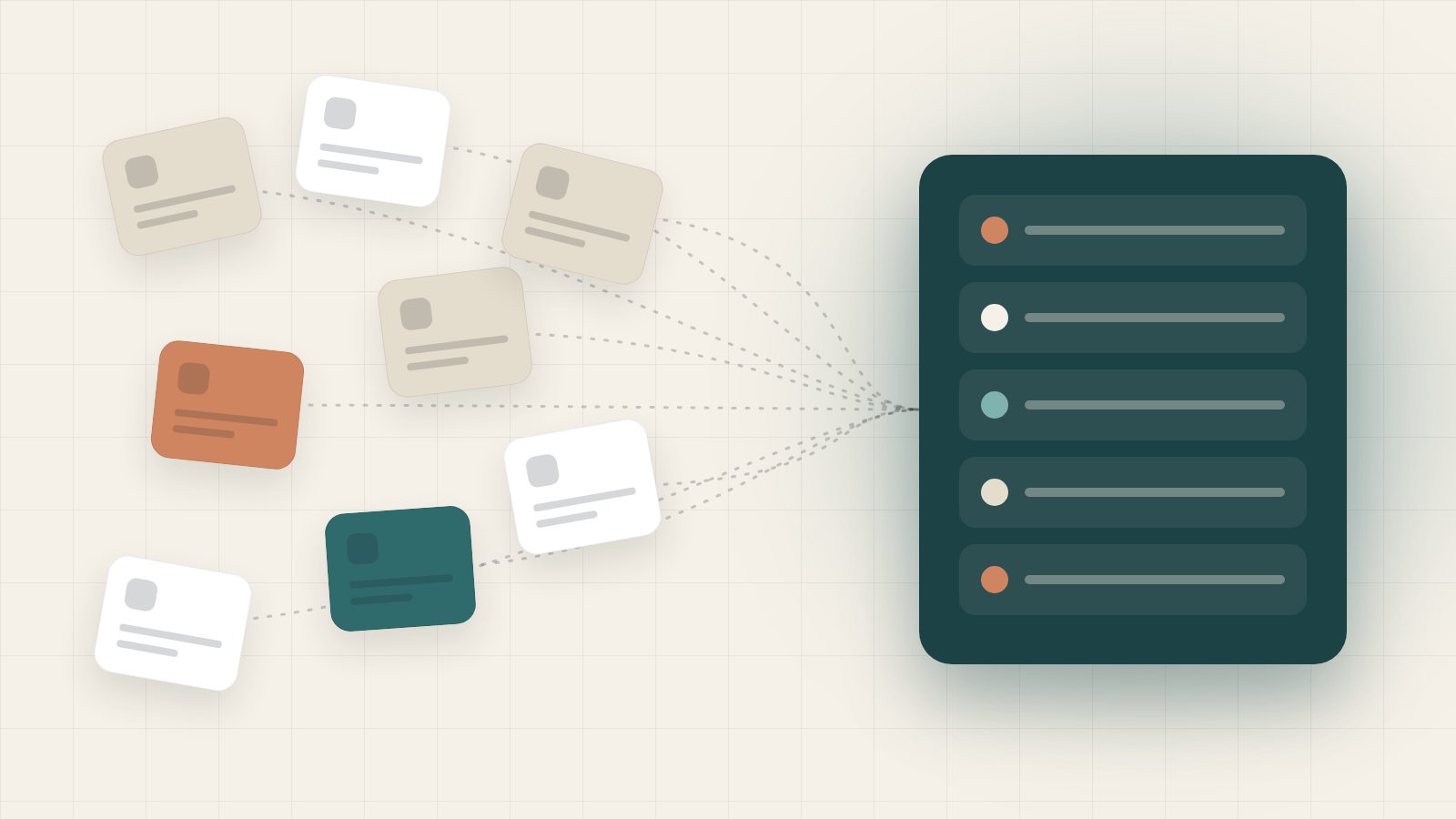
Almost no agency designs its software stack. It accumulates. The first CRM came with the first producers. A texting app arrived when clients stopped answering calls. Someone signed up for an e-signature tool to handle consent. The quoting site lives in another browser tab. Commissions are reconciled in a spreadsheet that one person understands. Every purchase solved a real problem, and every one added a seam.
This article is about those seams: where they appear, what they cost an insurance operation specifically, and how to decide when a patchwork should become a platform. It is written for owners and operations leaders who suspect their tools are slowing the team down but need a clearer way to frame the decision.
The typical insurance agency stack
| Job | Usual tool | What it knows | What it doesn't know |
|---|---|---|---|
| Lead and sales pipeline | Generic CRM | Contacts, deals, stages | Policies, households, carriers, renewals |
| Calls and texts | Standalone dialer or texting app | Conversations and numbers | Which client, policy or case the message belongs to |
| ACA quoting | Marketplace site in another tab | Plans, premiums, subsidies | The opportunity, the follow-up, the household in your CRM |
| Consent and forms | E-signature tool | Signed documents | Where those documents need to live for audits |
| Enrollment data | Enrollment platform exports | Applications and policy status | Your ownership, tasks and service history |
| Commissions | Spreadsheet | Statements and splits | Which policies are active, lapsed or changed agent of record |
Look at the last column. Each tool is competent at its own job and blind to the rest of the operation. The agency pays for that blindness with human effort: people copying data between screens, reconciling versions and asking colleagues what happened.
Four costs that never show up on an invoice
Subscription fees are visible. The expensive part of a patchwork is not. In insurance operations it usually shows up in four places.
- 01Re-keying. The same name, date of birth, income and household are typed into three or four systems. Each copy is a chance for a typo that later becomes a data matching issue or a wrong renewal.
- 02Context loss. A client texts about a premium change. The agent who answers can't see the policy, the last quote or the open case. The client repeats the story; the agent guesses.
- 03Invisible ownership. When a lead, a document request or a renewal lives in a personal inbox or a phone, nobody else knows it exists. Managers find out when it's already late.
- 04Unanswerable questions. How many renewals were contacted before the due date? Which lead source produces clients who stay? Which agent-of-record changes cost us commission? With the data spread across tools, these questions take days or never get answered.
A useful test: pick a client at random and try to reconstruct the last 90 days of their relationship with your agency. Count how many tools you had to open and how many colleagues you had to ask.
Spreadsheets are the most common glue in an agency stack, and the most fragile. Read: the hidden cost of spreadsheets
Why integrations alone rarely fix it
The natural reaction is to connect the tools: a Zapier flow here, a webhook there. Integrations help, but they have limits that matter in insurance.
- They move data, not meaning. A generic CRM can receive a policy number, but it has no notion of a household, a carrier, an effective date or an agent of record. The field arrives; the logic around it doesn't.
- They multiply failure points. Each connector can break silently. During Open Enrollment, a broken sync discovered two weeks late is a real operational incident.
- They don't create ownership. Moving a record between systems doesn't assign it to someone, set a due date or tell a manager it's overdue.
- They freeze the process. Once five tools are chained together, changing the renewal process means rewiring the chain, so nobody changes it.
Integrations are the right answer when the core system already understands insurance and only needs to exchange data with specialized sources. They're the wrong answer when they are trying to make a generic core behave like an insurance system.
What an operating platform means in practice
An operating platform is not just a CRM with more features. It's a system where every stage of the client lifecycle writes to the same record, so the next stage starts with full context. For an insurance agency, that lifecycle looks like this:
Capture
Lead arrives from a form, call or message and is assigned an owner
Qualify
An agent or AI assistant collects needs, household and income
Quote
Plans are compared inside the client journey, not in another tab
Consent
Consent and supporting forms are signed and attached to the record
Policy
The policy and household members are active and linked to the client
Service
Calls, texts and cases stay on the same timeline all year
Renew
Renewal campaigns start from the portfolio, with owner and status
Commission
Commissions reconcile against the policies that actually exist
Each step is ordinary on its own. The difference is that nothing has to be re-entered or looked up elsewhere. A renewal campaign knows which households have income changes pending. A commission discrepancy points to the policy and the agent-of-record history. A new service agent can read the whole relationship in one screen.
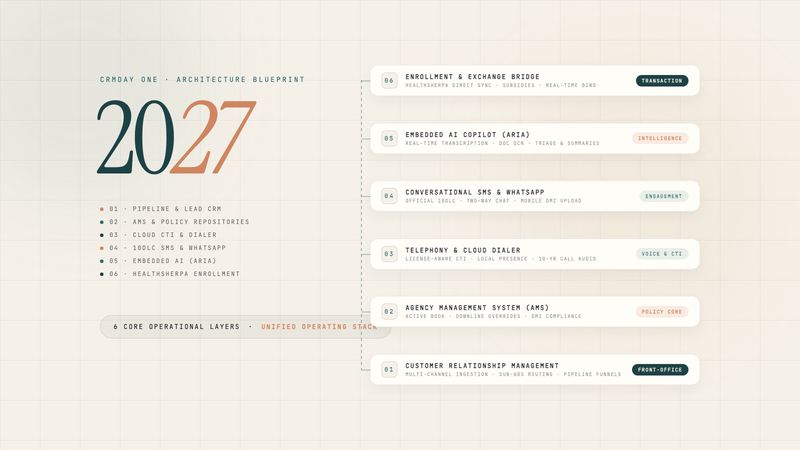
CRMDAY OneOne record from first lead to reconciled commissionCRMDAY One brings clients, households, policies, pipeline, embedded Healthcare.gov quoting, signed forms, Open Enrollment orchestration and omnichannel service into one operation, with AI, voice, network and commission capabilities added as your agency needs them.See how CRMDAY One worksSignals that your patchwork has reached its limit
Not every agency needs to consolidate today. A two-person shop with a small book can live with a few tools. These are the signals that the cost of seams has crossed the cost of change:
- You hired service staff and response times didn't improve.
- Open Enrollment requires a separate spreadsheet to track who was contacted.
- You can't say, within a day, how many active policies each agent owns.
- Consent and signed forms are stored in a tool that isn't linked to the client.
- Commission reconciliation takes more than a few days per cycle.
- A producer leaving the agency would take unknown information with them.
- Managers learn about problems from clients, not from the system.
“The question isn't whether each tool works. It's whether the agency can see itself as one operation.”
How to move without stopping the agency
Consolidation fails when it's treated as a weekend migration. It works when it follows the rhythm of the operation. A practical sequence:
- 01Map the lifecycle, not the tools. Write down the eight stages above as your agency runs them today, and note where each piece of data is created and where it's copied.
- 02Pick the system of record. Decide which platform owns clients, households and policies. Everything else either moves there or feeds it.
- 03Start with the book, not the leads. Import active clients and policies first. Retention is where the value is, and a clean book makes every later step easier.
- 04Move channels next. Once calls and messages land on the client timeline, the team feels the difference in the first week.
- 05Retire tools deliberately. Cancel a tool only after its job has been running in the new platform for one full cycle.
- 06Time it against the calendar. For ACA agencies, the months before November 1 are the window; migrating during Open Enrollment is a risk few operations should take.
Want the detailed version with phases, owners and checkpoints? Read the insurance CRM migration plan
What to ask any platform you evaluate
| Question | Why it matters |
|---|---|
| Does it model households and policies natively? | Retention, renewals and cross-sell depend on it |
| Can quoting happen inside the client record? | The quote is the moment context is most often lost |
| Do messages from every channel land on one timeline? | Service quality depends on seeing the whole conversation |
| Are signed consent and forms attached to the client? | Audit readiness shouldn't depend on a separate tool |
| Can Open Enrollment run as a campaign with owners? | Seasonal peaks are where patchworks collapse |
| Can advanced capabilities be added later? | You shouldn't pay for AI or commissions before you need them |
Moving from a tool stack to an operating platform is less about technology than about deciding that the agency deserves a single, reliable picture of itself. Once that picture exists, every other improvement, from AI to commission accuracy, has somewhere solid to stand.
Next step
See what a structured insurance operation looks like.
Explore CRMDAY One, the platform we built for independent agents, agencies and FMOs, or keep learning with our evaluation guides.